Dear maria,
We just published a new blog—please find the full text below. Translations coming soon.
By Vitor Gaspar and Gita Gopinath
The ongoing COVID-19 pandemic has already prompted an unprecedented fiscal policy response of close to $11 trillion worldwide. But with confirmed cases and fatalities still rising fast, policymakers will have to keep the public health response their No. 1 priority while retaining supportive and flexible fiscal policies and preparing for transformational economic change.
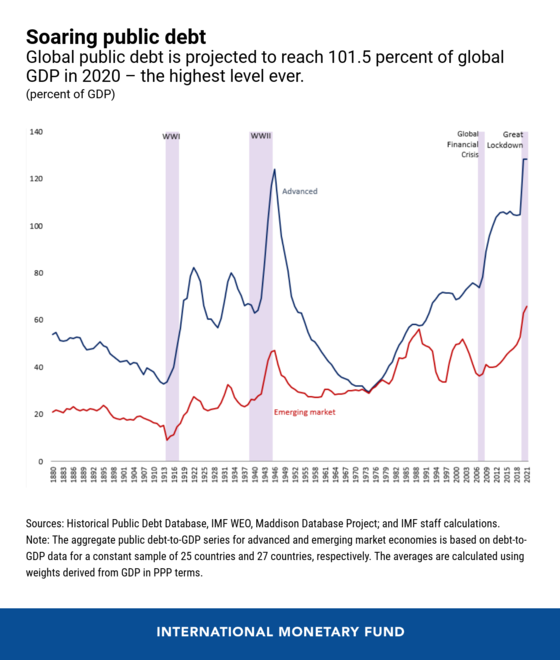
In the face of a sharp decline in global output, a massive fiscal response has been necessary to increase health capacity, replace lost household income and prevent large-scale bankruptcies. But the policy response has also contributed to global public debt reaching its highest level in recorded history, at over 100 percent of global GDP, in excess of post-World War II peaks.
According to the Fiscal Monitor database of country fiscal measures in response to the COVID-19 pandemic, covering a representative sample of over 50 countries, total global fiscal support so far has been split almost evenly between above-the-line – measures with a direct effect on revenue and expenditure such as deferral of taxes and cash transfers– and below-the-line support, which includes public sector loans, equity injections and government guarantees.

Fiscal policy for the gradual reopening from the Great Lockdown
The need for fiscal action does not end here, as we are not out of the woods. Even as many countries tentatively exit the Great Lockdown, in the absence of a solution to the health crisis, huge uncertainties remain about the path of the recovery.
The top priority is still public health. Policies that attenuate health risks contribute substantially to the restoration of confidence and trust, thereby helping economic activity and employment and reducing strains on public finances. And going forward, early and targeted containment procedures will have much more limited economic and fiscal costs, as compared to a general lockdown. Accurate, timely and comprehensive data on health and socio-economic outcomes are essential to monitor outbreaks and react swiftly to them, and provide confidence to people that future waves of contagion can be handled.
Second, fiscal policy will need to remain supportive and flexible until a safe and durable exit from the crisis is secured. While the trajectory of public debt could drift up further in an adverse scenario, an earlier-than-warranted fiscal retrenchment presents an even greater risk of derailing the recovery, with larger future fiscal costs. Policymakers should prepare contingent plans that can be flexibly scaled to manage the health, economic and fiscal risks from recurrent outbreaks. To prevent lags in delivery of targeted support, a new generation of automatic stabilizers may be needed.
Third, the crisis will be transformational. Many of the jobs destroyed by the crisis will likely not return. It will be necessary to facilitate the transfer of resources from sectors that may permanently shrink, such as air travel, to sectors that will be expanding, such as digital services. Support should move from maintaining jobs to supporting people as they retrain or relocate across sectors. It will be necessary to distinguish illiquid but solvent firms from insolvent ones. Governments might take further steps, such as using convertible bonds and injecting equity into (or even temporarily nationalizing) strategic and systemic firms. Many countries will also need to take swift and determined actions to improve legal mechanisms for resolving debt overhang and preventing long-run economic scarring.
Keeping debt levels sustainable
The need for continued fiscal support is clear, but this begs the question of how countries can finance it without debt becoming unsustainable. In 2020, relative to the January 2020 World Economic Outlook, fiscal deficits are expected to be more than five times higher in advanced economies (AEs) and to more than double in emerging market economies (EMEs), leading to an unprecedented jump in public debt of respectively 26 and 7 percentage points of GDP.

Many governments will benefit from borrowing costs that are at historical lows and projected to stay that way for a long time as the crisis raises precautionary savings and dampens investment demand. Moreover, with economies projected to function below potential for a while, inflationary pressures will remain muted and so will the need for central banks to raise interest rates. Public debt is expected to stabilize in 2021 (excluding the United States and China), spurred by low interest rates and a projected strong rebound in economic activity in the baseline.

Still, caution is advised. There is a great diversity in debt levels and financing abilities across countries and high uncertainty surrounding the forecasts. Borrowing costs can increase rapidly, particularly for emerging economies and frontier markets, as was the case in March. Ensuring a path back to sustainable fiscal balances will also be key in countries that entered this crisis with already elevated debt and low growth. Governments will need to pursue a credible medium-term fiscal plan that relies on improving revenue mobilization – including through minimizing tax avoidance, greater tax progressivity in some cases, carbon pricing and higher efficiency in spending (for example, eliminating fossil fuel subsidies). Transparent communication of any plan will help contain potential volatility in sovereign debt markets in the transition. Moreover, international institutions must ensure that access to international liquidity is not disrupted by self-fulfilling market panics.
The international community must also ensure that vulnerable low-income developing countries (LIDCs) lacking the resources to support healthcare systems and sustain lifelines have access to concessional financing and, in some cases, grants. Seventy-two countries have already received IMF emergency assistance, but far more bilateral and multilateral support will be needed. And poorer nations may need continued debt relief, including through the G20 Debt Service Suspension Initiative.
Fiscal Policies post-COVID 19
Once effective vaccine and therapeutics against COVID-19 are widely available, we will enter a post-COVID world and truly escape the Great Lockdown. That will only be possible if international solidarity allows for access to treatment and vaccines for all people, in developed and developing countries alike. At that stage, governments should redirect fiscal policy toward resilient, sustainable and inclusive growth.
Policymakers should tackle the rising poverty and inequality, as well as the structural weaknesses exposed by the crisis to better prepare for future shocks. This includes investing in stronger health systems, better resourced social safety nets and digitalization. Authorities should actively support climate-friendly investments that promote greener, job-rich and innovation-driven growth. Fiscal policy must also tackle inequality through spending aimed at universal access to health and education and progressive tax systems.
It is not possible to forecast with great confidence how the post-COVID 19 world will look. For sure, transformations will be profound. Whatever the future looks like, it will require flexible fiscal policies that facilitate structural change, address inequality and support the transition to a greener future.
Take good care,
| 




Σχόλια
Δημοσίευση σχολίου
Eυπρόσδεκτα τα σχόλιά Σας...