| European Works Councils (EWCs) are bodies that should guarantee employees the right to be consulted on important issues in large multinational companies active in multiple EU countries. However, EWCs have been criticised for being ineffective, on account of unclear definitions, non-dissuasive sanctions and ineffective access to justice. In February 2023, the European Parliament called for legislative action to address the shortcomings identified and strengthen the functioning of EWCs. In response, the European Commission consulted European social partners and put forward a proposal in January 2024 to revise the 2009 directive. The European Parliament's Committee on Employment and Social Affairs voted its report on 3 April 2024 just ahead of the elections. The Council then adopted its general approach on 20 June 2024. On 3 December 2024, the committee decided to enter interinstituional negotiations on the basis of the report, with the mandate confirmed by plenary vote on 19 December. Trilogue negotiations have now started. Third edition. The 'EU Legislation in Progress' briefings are updated at key stages throughout the legislative procedure. Πηγή : © Ευρωπαϊκή Ένωση, 2025 - EK | |
European Works Councils (EWCs) are bodies that should guarantee employees the right to be consulted on important issues in large multinational companies active in multiple EU countries. However, EWCs have been criticised for being ineffective, on account of unclear definitions, non-dissuasive sanctions and ineffective access to justice. In February 2023, the European Parliament called for legislative action to address the shortcomings identified and strengthen the functioning of EWCs. In response, the European Commission consulted European social partners and put forward a proposal in January 2024 to revise the 2009 directive. The European Parliament's Committee on Employment and Social Affairs voted its report on 3 April 2024 just ahead of the elections. The Council then adopted its general approach on 20 June 2024. On 3 December 2024, the committee decided to enter interinstituional negotiations on the basis of the report, with the mandate confirmed by plenary vote on 19 December. Trilogue negotiations have now started. Third edition. The 'EU Legislation in Progress' briefings are updated at key stages throughout the legislative procedure. Πηγή : © Ευρωπαϊκή Ένωση, 2025 - EK | |
At the meeting on 18 March 2025, the JURI Committee voted on the draft opinion on The Commission’s 2024 Rule of Law report (2024/2078(INI)) and on Pilot Projects and Preparatory Actions (PPPAs). The Members also considered the draft report on Enforcement of measures and cooperation in matters relating to the protection of adults (2023/0169(COD)) and on the draft opinion on transparency of interest representation carried out on behalf of third countries (2023/0463(COD)). Finally, the JURI committee held two events jointly with other committees: - Hearing on on the protection and promotion of the rights of children (jointly with EMPL)
- Exchange of views with Judge Tomoko Akane, President of the International Criminal Court (jointly with DROI).
|
Latvia is set to receive non-repayable financial support (grants) worth €1 969 million to implement its national recovery and resilience plan (NRRP), including for the REPowerEU chapter. These resources represent 0.3 % of the RRF, equal to 6.4 % of the country's gross domestic product (GDP) in 2019. Under the Recovery and Resilience Facility (RRF), the original plan had an initial value of €1 826 million. In June 2022, Latvia's grant allocation was increased by €9 million. In September 2023, Latvia submitted a request to amend its NRRP, to which it added a REPowerEU chapter endowed with an additional grant allocation of €124 million. It also requested to transfer a portion of its share of the Brexit Adjustment Reserve to its plan (€11 million). In December 2023, the Council adopted an amending implementing decision greenlighting the modified plan. In December 2024, Latvia submitted a second modified NRRP, where amendments concerned 28 measures. In February 2025, the Council approved the new revision of Latvia's plan. The current plan contains 25 reforms and 63 investment measures to be completed by 31 August 2026. Latvia has so far received 40.7 % of the resources, or €801 million, in the form of pre-financing, and two payments of grants (see annex to this briefing). A further four payments for grants will depend on progress made in implementing the plan. Latvia's plan is consistent with the challenges and priorities identified in the European Semester, the annual cycle of coordination and monitoring of EU countries' economic policies. The European Parliament participates in interinstitutional forums for cooperation and discussion on the implementation of the RRF and continues to scrutinise the European Commission's work. This briefing is one in a series covering all EU Member States. Fourth edition. The 'NGEU delivery' briefings are updated at key stages throughout the lifecycle of the plans. Πηγή : |
The next meeting of the Subcommittee on Human Rights is scheduled to take place on Monday, 7 April and Tuesday, 8 April in Brussels (meeting room Spinelli 1G2) Source : © European Union, 2025 - EP | |
DEVE Committee members will participate in the Nutrition for Growth Summit in Paris on 27 and 28 March to support the Team Europe efforts towards ending malnutrition. DEVE has consistently advocated to mobilize global action to support nutrition, promote food security and build resilient food systems and agriculture. Malnutrition is the leading cause of infant mortality worldwide and addressing it is key to SDG 2 to eradicate hunger and malnutrition. As part of the summit, DEVE Committee together with the Generation Nutrition Coalition organise a side event on Thursday 27 March from 19.00 at "Europa Expérience" focused on sustaining and strengthening responses to nutritional crises in fragile and conflict-affected settings. Members will discuss both the financial as well as political commitments that need to be sustained in the fight against malnutrition. Composition of the delegation: · Mr Barry Andrews DEVE Chair (Renew, IE) ; · Ms Leire Pajín (S&D, ES) · Ms Murielle Laurent (S&D, FR) · Mr Vlad Voiculescu (Renew, RO) Malnutrition is responsible for nearly one in two deaths among children under five. Malnutrition, in all its forms - undernutrition, deficiencies, overweight or obesity - is a major global challenge, affecting both developed and developing countries. |
REPORT on the request for waiver of the immunity of Mariusz Kamiński Committee on Legal Affairs Mario Furore Source : © European Union, 2025 - EP | |
REPORT on the proposal for a directive of the European Parliament and of the Council amending Directive 2005/44/EC on harmonised river information services (RIS) on inland waterways in the Community Committee on Transport and Tourism Tom Berendsen Source : © European Union, 2025 - EP
| | NOTICE TO MEMBERS Petition No 1328/2015 by Renato Amoroso (Italian) on the statute on Justices of the Peace in Italy Petition No 1376/2015 by Vincenzo Colantuoni Romagnoli (Italian) on the treatment of honorary judges (Justices of the Peace) in Italy Petition No 0028/2016 by I.B. (Italian) on Justices of the Peace in Italy Petition No 0044/2016 by Manuela Cardillo (Italian), on the legal status of Italian sub-district court judges Petition No 0177/2016 by D. B. (Italian) on conditions of employment for Justices of the Peace in Italy Petition No 0214/2016 by E. A. (Italian) on Justices of the Peace in Italy Petition No 0333/2016 by M. C. (Italian) on Justices of the Peace in Italy Petition No 0889/2016 by Claudio Fiorentino (Italian) on the ‘organic reform’ of the honorary magistracy stemming from a government delegated law Petition No 1184/2016 by Maria Barbara Cerminara (Italian) on the incompatibility of the working conditions of honorary magistrates in Italian courts with European law Petition No 1202/2016 by Paola Bellone (Italian) on the violation by Italy of European legislation on the economic treatment of honorary court judges and honorary assistant prosecutors Petition No 0757/2017 by Pierpaolo Volpe (Italian) on the working conditions of honorary judges in Italy Petition No 0763/2017 by V. E. (Italian) on a legal dispute concerning pension entitlements Petition No 0778/2017 by Letizia Spaventa (Italian) on the working conditions of honorary magistrates in Italy Petition No 0779/2017 by Pasqualino Ludovico (Italian), on the working conditions of honorary magistrates in Italy Petition No 0780/2017 by Michele Chimienti (Italian), on the working conditions of honorary magistrates in Italy Petition No 1365/2021 by A.M. (Italian) on the proposed amendment of Article 196 of the Italian budget law for 2021 Petition No 0695/2023 by Mariaflora Di Giovanni (Italian), on behalf of the National Union of Justices of the Peace (UNAGIPA), on the presumed breach by Italy o | |
NOTICE TO MEMBERS Petition No 1208/2024 by Maria Zacharia (Greek) on the alleged incorrect transposition in Greece of Directive (EU) 2022/2041 on adequate minimum wages in the European Union Committee on Petitions Source : © European Union, 2025 - EP | |
NOTICE TO MEMBERS Petition No 1174/2024 by Pasquale Mancino (Italian) on establishing the position of workers’ privacy officer by amending Regulation (EU) 2016/679 Committee on Petitions Source : © European Union, 2025 - EP | |
NOTICE TO MEMBERS Petition No 0136/2024 by H. K. (German), bearing 7 other signatures, on the environmental impact of the Baden-Württemberg regional development plan in Germany Committee on Petitions Source : © European Union, 2025 - EP | |
NOTICE TO MEMBERS Petition No 1201/2024 by Michael Maier (German) on Regulations (EU) 2017/745 (MDR) and 2017/746 (IVDR) Committee on Petitions Source : © European Union, 2025 - EP | |
NOTICE TO MEMBERS Petition No 1197/2024 by L. K. (German) on inadequate implementation of Article 51 GDPR Committee on Petitions Source : © European Union, 2025 - EP | |
NOTICE TO MEMBERS Petition No 1100/2023 by Tünde Irma Horváth (Hungarian) on the application of EU law by the Courts in Hungary Committee on Petitions Source : © European Union, 2025 - EP | |
NOTICE TO MEMBERS Petition No 0010/2024 by Giuditta Sborgi (Italian) on works to redevelop the ‘Colonia Ugo Pisa’ residential holiday complex in Marina di Massa, Italy Committee on Petitions Source : © European Union, 2025 - EP | |
NOTICE TO MEMBERS Petition No 0106/2024 by E. G. (French) on alleged breach of Directive 2002/49/EC on the assessment and management of environmental noise in the area around Faro airport in Portugal Committee on Petitions Source : © European Union, 2025 - EP | |
NOTICE TO MEMBERS Petition No 0043/2024 by P. H. B. (German) on the standardisation of pensioner cards in the EU Committee on Petitions Source : © European Union, 2025 - EP | |
DRAFT REPORT on the proposal for a directive of the European Parliament and of the Council establishing harmonised requirements in the internal market on transparency of interest representation carried out on behalf of third countries and amending Directive (EU) 2019/1937 Committee on the Internal Market and Consumer Protection Adina Vălean Source : © European Union, 2025 - EP | |
On 18 March, the Internal Market and Consumer Protection Committee (IMCO) hosted a public hearing about the enforcement and implementation of the Digital Services Act (DSA). The aim of the hearing is to discuss the effective implementation and enforcement of the DSA. IMCO invited high-level representatives of the Commission, representatives of companies (key platforms and non-VLOPs) and Member States' authorities, as well as other stakeholders (trusted flaggers, researchers, academics, NGOs and organisations representing consumers' interests) in order to discuss the state of play and challenges related to the implementation and enforcement of the DSA. The exchange of views addressed main compliance burdens and challenges in content moderation and transparency obligations, development of codes of conduct, safeguards for freedom of speech, as well as the protection of consumer rights in the digital market. | |
During the IMCO Committee meeting of 17 March 2025, the Chair, Anna Cavazzini, reported back on the key takeaways from the recent visit to Washington D.C. From 25 to 28 February 2025, IMCO Members held several meetings in Washington, D.C. The main aim of this visit was to strengthen transatlantic cooperation on key IMCO policy areas while obtaining feedback from U.S. stakeholders on the implementation and impact of major EU legislation. Discussions covered the Digital Services Act (DSA), Digital Markets Act (DMA), EU AI Act, Cyber Resilience Act (CRA), Data Act, and Political Advertising Regulation, among other topics. The visit also addressed shared challenges in digital innovation, cybersecurity, AI, and fair competition, while informed IMCO's parliamentary oversight and future legislative priorities.
The Members of the European Parliament who traveled to Washington for this parliamentary visit were Anna Cavazzini (IMCO Chair, Greens/EFA), Andreas Schwab (EPP), Pablo Arias Echeverría (EPP), Christel Schaldemose (S&D), Klára Dostálová (PfE), Piotr Müller (ECR), and Sandro Gozi (Renew). Location : Washington D.C. United States |
On 18 March, the Internal Market and Consumer Protection Committee (IMCO) hosted a public hearing about the enforcement and implementation of the Digital Services Act (DSA). The aim of the hearing is to discuss the effective implementation and enforcement of the DSA. IMCO invited high-level representatives of the Commission, representatives of companies (key platforms and non-VLOPs) and Member States' authorities, as well as other stakeholders (trusted flaggers, researchers, academics, NGOs and organisations representing consumers' interests) in order to discuss the state of play and challenges related to the implementation and enforcement of the DSA. The exchange of views addressed main compliance burdens and challenges in content moderation and transparency obligations, development of codes of conduct, safeguards for freedom of speech, as well as the protection of consumer rights in the digital market. Source : © European Union, 2025 - EP | |
During the IMCO Committee meeting of 17 March 2025, the Chair, Anna Cavazzini, reported back on the key takeaways from the recent visit to Washington D.C. From 25 to 28 February 2025, IMCO Members held several meetings in Washington, D.C. The main aim of this visit was to strengthen transatlantic cooperation on key IMCO policy areas while obtaining feedback from U.S. stakeholders on the implementation and impact of major EU legislation. Discussions covered the Digital Services Act (DSA), Digital Markets Act (DMA), EU AI Act, Cyber Resilience Act (CRA), Data Act, and Political Advertising Regulation, among other topics. The visit also addressed shared challenges in digital innovation, cybersecurity, AI, and fair competition, while informed IMCO's parliamentary oversight and future legislative priorities.
The Members of the European Parliament who traveled to Washington for this parliamentary visit were Anna Cavazzini (IMCO Chair, Greens/EFA), Andreas Schwab (EPP), Pablo Arias Echeverría (EPP), Christel Schaldemose (S&D), Klára Dostálová (PfE), Piotr Müller (ECR), and Sandro Gozi (Renew).
Source : © European Union, 2025 - EP | |
During this legislative term of the European Parliament, the IMCO Coordinators and the LIBE Coordinators established a Joint Working Group (WG) on the implementation and enforcement of the Artificial Intelligence Act to scrutinise the implementation of the AI Act and report its findings to the Committee. On 17 March 2025, WG Co-Chair Brando Benifei (S&D) briefed IMCO Members on the outcome of the WG meeting held on 19 February, highlighting progress on the AI Act Code of Practice and engagement with the AI Office.
Key updates include expanded disclosure obligations and compliance indicators but concerns remain over transparency, copyright oversight and systemic risk assessment gaps. Governance issues persist, especially in defining serious incidents. Efforts continue to refine risk mitigation. |
During this legislative term of the European Parliament, the IMCO Coordinators and the LIBE Coordinators established a Joint Working Group (WG) on the implementation and enforcement of the Artificial Intelligence Act to scrutinise the implementation of the AI Act and report its findings to the Committee. On 17 March 2025, WG Co-Chair Brando Benifei (S&D) briefed IMCO Members on the outcome of the WG meeting held on 19 February, highlighting progress on the AI Act Code of Practice and engagement with the AI Office.
Key updates include expanded disclosure obligations and compliance indicators but concerns remain over transparency, copyright oversight and systemic risk assessment gaps. Governance issues persist, especially in defining serious incidents. Efforts continue to refine risk mitigation. |
On 18 March 2025, Rapporteur Alex Agius Saliba (S&D) presented his proposals on the Package Travel Directive. IMCO Members discussed this draft report, along with the proposals previously put forward by the Commission. These proposals aim to clarify certain rules on package travel, particularly in light of the Covid-19 pandemic, which significantly impacted both the travel industry and travellers. Mr Agius Saliba's draft report addresses certain provisions of the Commission's proposals, aiming to keep the rules simple for businesses while ensuring strong consumer protection. Members may table further amendments by 26 March at noon. Source : © European Union, 2025 - EP | |
On 18 March 2025, Rapporteur Alex Agius Saliba (S&D) presented his proposals on the Package Travel Directive. IMCO Members discussed this draft report, along with the proposals previously put forward by the Commission. These proposals aim to clarify certain rules on package travel, particularly in light of the Covid-19 pandemic, which significantly impacted both the travel industry and travellers. Source : © European Union, 2025 - EP | |
The first trilogue meeting on Alternative Dispute Resolution (ADR) took place on Thursday, 20 February, 2025. While the European Parliament and the Council have already agreed on discontinuing the Online Dispute Resolution (ODR) Platform, negotiations now focus on ADR reforms. The European Parliament’s Internal Market and Consumer Protection (IMCO) Committee recently adopted two key reports: one amending the ADR Directive and another ending the ODR Platform. Rapporteur MEP Laura Ballarín Cereza (S&D) led the discussions, with the plenary vote held on 13 March 2024. IMCO Members also voted on a second-reading recommendation for discontinuing the ODR Platform on 3 December 2024. In a nutshell, the rules provide for: • Passengers to benefit from new mandatory participation of airline carriers • Discontinuation of underused online platform to make way for more effective tools • Need to increase consumer awareness of existing alternative dispute resolution processes The Rapporteur said: "We propose a system that is fair to consumers and traders, an ADR mechanism that is more useful. We want better involvement of traders in sectors with more complaints, so we make the participation in ADR compulsory for airlines. We aim to raise awareness of these tools by requiring traders to include information on ADR mechanism on their websites and invoices. In addition, the trader has to respond within 20 days after a complaint is filed." | |
On 18 March, Rapporteur, Salvatore De Meo (EPP) presented his report in IMCO. The report addresses key regulatory challenges in e-commerce, including unsafe imports, unfair competition, and enforcement gaps. It supports the revision of the EU Customs Code to improve e-commerce import controls, enhance cooperation through a new EU Customs Authority and Data Hub, and remove the EUR 150 customs duty exemption. It also advocates for the 'deemed importer' concept to hold online sellers accountable. Additionally, it calls for stronger enforcement via AI-driven market surveillance and enhanced resources for customs authorities.
The Commission designated nine online marketplaces as Very Large Online Platforms (VLOPs), subject to VLOPs' obligations, including risk mitigation, transparency of recommender systems, and Know Your Business Customer (KYBC) requirements. Source : © European Union, 2025 - EP | |
On February 11, the European Commission announced in its 2025 work programme its intention to withdraw the AI Liability Directive (AILD) within six months, citing "no foreseeable agreement" among EU lawmakers and member states. This aligns with IMCO Rapporteur Kosma Złotowski's draft opinion, presented on February 18, 2025, which deemed the AILD premature and unnecessary. IMCO will continue its legal work until the leading JURI Committee finalises its position, with the next step for IMCO being the consideration of amendments scheduled for March 17-18, 2025.
Source : © European Union, 2025 - EP | |
JOINT MOTION FOR A RESOLUTION pursuant to Rule 136(2) and (4) of the Rules of Procedure replacing the following motions: B10-0146/2025 (PPE) B10-0147/2025 (Verts/ALE) B10-0148/2025 (Renew) B10-0149/2025 (ECR) B10-0150/2025 (S&D) on the white paper on the future of European defence (2025/2565(RSP)) Rasa Juknevičienė, Nicolás Pascual de la Parte, Riho Terras, Michael Gahler, David McAllister, Sebastião Bugalho, Andrzej Halicki, Inese Vaidere, Wouter Beke on behalf of the PPE Group Yannis Maniatis, Sven Mikser on behalf of the S&D Group Reinis Pozņaks, Rihards Kols, Aurelijus Veryga, Cristian Terheş, Assita Kanko, Alexandr Vondra, Veronika Vrecionová, Ondřej Krutílek, Roberts Zīle, Joachim Stanisław Brudziński on behalf of the ECR Group Nathalie Loiseau, Dan Barna, Sandro Gozi, Anna-Maja Henriksson, Karin Karlsbro, Ľubica Karvašová, Urmas Paet, Marie-Agnes Strack-Zimmermann, Eugen Tomac, Hilde Vautmans, Sophie Wilmès, Lucia Yar, Dainius Žalimas on behalf of the Renew Group Reinier Van Lanschot on behalf of the Verts/ALE Group Source : © European Union, 2025 - EP | |
On 20 January 2025, President Trump halted all US foreign aid pending a review. By 10 March, 83 % of USAID programmes had been terminated, creating a US$60 billion funding gap that neither Team Europe – the EU and its Member States collectively – nor other donors can fill, amid declining global official development assistance (ODA). This infographic uses OECD Development Assistant Committee (DAC) data on 2023 ODA commitments and disbursements. Commitments are pledged funds reflecting donor priorities, while disbursements show actual transfers, tracked yearly. Since disbursements often span multiple years, annual payments may stem from past commitments. Commitments are recorded in full when made, while disbursements track the timing of aid. Source : © European Union, 2025 - EP | |
At the meeting on 18 March 2025, the JURI Committee voted on the draft opinion on The Commission’s 2024 Rule of Law report (2024/2078(INI)) and on Pilot Projects and Preparatory Actions (PPPAs). The Members also considered the draft report on Enforcement of measures and cooperation in matters relating to the protection of adults (2023/0169(COD)) and on the draft opinion on transparency of interest representation carried out on behalf of third countries (2023/0463(COD)). Finally, the JURI committee held two events jointly with other committees: - Hearing on on the protection and promotion of the rights of children (jointly with EMPL)
- Exchange of views with Judge Tomoko Akane, President of the International Criminal Court (jointly with DROI).
|
European Works Councils (EWCs) are bodies that should guarantee employees the right to be consulted on important issues in large multinational companies active in multiple EU countries. However, EWCs have been criticised for being ineffective, on account of unclear definitions, non-dissuasive sanctions and ineffective access to justice. In February 2023, the European Parliament called for legislative action to address the shortcomings identified and strengthen the functioning of EWCs. In response, the European Commission consulted European social partners and put forward a proposal in January 2024 to revise the 2009 directive. The European Parliament's Committee on Employment and Social Affairs voted its report on 3 April 2024 just ahead of the elections. The Council then adopted its general approach on 20 June 2024. On 3 December 2024, the committee decided to enter interinstituional negotiations on the basis of the report, with the mandate confirmed by plenary vote on 19 December. Trilogue negotiations have now started. Third edition. The 'EU Legislation in Progress' briefings are updated at key stages throughout the legislative procedure. Source : © European Union, 2025 - EP | |
European Works Councils (EWCs) are bodies that should guarantee employees the right to be consulted on important issues in large multinational companies active in multiple EU countries. However, EWCs have been criticised for being ineffective, on account of unclear definitions, non-dissuasive sanctions and ineffective access to justice. In February 2023, the European Parliament called for legislative action to address the shortcomings identified and strengthen the functioning of EWCs. In response, the European Commission consulted European social partners and put forward a proposal in January 2024 to revise the 2009 directive. The European Parliament's Committee on Employment and Social Affairs voted its report on 3 April 2024 just ahead of the elections. The Council then adopted its general approach on 20 June 2024. On 3 December 2024, the committee decided to enter interinstituional negotiations on the basis of the report, with the mandate confirmed by plenary vote on 19 December. Trilogue negotiations have now started. Third edition. The 'EU Legislation in Progress' briefings are updated at key stages throughout the legislative procedure. Source : © European Union, 2025 - EP | |
On 24 March, Parliament’s Special Committee on the Housing Crisis will host a conference with the Commission to discuss ways to ensure EU citizens can access affordable housing. Special committee on the Housing Crisis in the European Union Source : © European Union, 2025 - EP | |
On 24 March, Parliament’s Special Committee on the Housing Crisis will host a conference with the Commission to discuss ways to ensure EU citizens can access affordable housing. Special committee on the Housing Crisis in the European Union Source : © European Union, 2025 - EP | |
At the meeting on 18 March 2025, the JURI Committee voted on the draft opinion on The Commission’s 2024 Rule of Law report (2024/2078(INI)) and on Pilot Projects and Preparatory Actions (PPPAs). The Members also considered the draft report on Enforcement of measures and cooperation in matters relating to the protection of adults (2023/0169(COD)) and on the draft opinion on transparency of interest representation carried out on behalf of third countries (2023/0463(COD)). Finally, the JURI committee held two events jointly with other committees: - Hearing on on the protection and promotion of the rights of children (jointly with EMPL)
- Exchange of views with Judge Tomoko Akane, President of the International Criminal Court (jointly with DROI).
|
Latvia is set to receive non-repayable financial support (grants) worth €1 969 million to implement its national recovery and resilience plan (NRRP), including for the REPowerEU chapter. These resources represent 0.3 % of the RRF, equal to 6.4 % of the country's gross domestic product (GDP) in 2019. Under the Recovery and Resilience Facility (RRF), the original plan had an initial value of €1 826 million. In June 2022, Latvia's grant allocation was increased by €9 million. In September 2023, Latvia submitted a request to amend its NRRP, to which it added a REPowerEU chapter endowed with an additional grant allocation of €124 million. It also requested to transfer a portion of its share of the Brexit Adjustment Reserve to its plan (€11 million). In December 2023, the Council adopted an amending implementing decision greenlighting the modified plan. In December 2024, Latvia submitted a second modified NRRP, where amendments concerned 28 measures. In February 2025, the Council approved the new revision of Latvia's plan. The current plan contains 25 reforms and 63 investment measures to be completed by 31 August 2026. Latvia has so far received 40.7 % of the resources, or €801 million, in the form of pre-financing, and two payments of grants (see annex to this briefing). A further four payments for grants will depend on progress made in implementing the plan. Latvia's plan is consistent with the challenges and priorities identified in the European Semester, the annual cycle of coordination and monitoring of EU countries' economic policies. The European Parliament participates in interinstitutional forums for cooperation and discussion on the implementation of the RRF and continues to scrutinise the European Commission's work. This briefing is one in a series covering all EU Member States. Fourth edition. The 'NGEU delivery' briefings are updated at key stages throughout the lifecycle of the plans. Source : |
Latvia is set to receive non-repayable financial support (grants) worth €1 969 million to implement its national recovery and resilience plan (NRRP), including for the REPowerEU chapter. These resources represent 0.3 % of the RRF, equal to 6.4 % of the country's gross domestic product (GDP) in 2019. Under the Recovery and Resilience Facility (RRF), the original plan had an initial value of €1 826 million. In June 2022, Latvia's grant allocation was increased by €9 million. In September 2023, Latvia submitted a request to amend its NRRP, to which it added a REPowerEU chapter endowed with an additional grant allocation of €124 million. It also requested to transfer a portion of its share of the Brexit Adjustment Reserve to its plan (€11 million). In December 2023, the Council adopted an amending implementing decision greenlighting the modified plan. In December 2024, Latvia submitted a second modified NRRP, where amendments concerned 28 measures. In February 2025, the Council approved the new revision of Latvia's plan. The current plan contains 25 reforms and 63 investment measures to be completed by 31 August 2026. Latvia has so far received 40.7 % of the resources, or €801 million, in the form of pre-financing, and two payments of grants (see annex to this briefing). A further four payments for grants will depend on progress made in implementing the plan. Latvia's plan is consistent with the challenges and priorities identified in the European Semester, the annual cycle of coordination and monitoring of EU countries' economic policies. The European Parliament participates in interinstitutional forums for cooperation and discussion on the implementation of the RRF and continues to scrutinise the European Commission's work. This briefing is one in a series covering all EU Member States. Fourth edition. The 'NGEU delivery' briefings are updated at key stages throughout the lifecycle of the plans. Source : |
 This conference serves as a vital platform for exploring and enhancing the strategic partnership between the EU and Japan in the rapidly evolving fields of artificial intelligence and quantum technologies. By bringing together policymakers, industry leaders, and researchers, the event aims to foster dialogue and collaboration, paving the way for innovative solutions that benefit both regions. The first part of the Conference will delve into the policy and regulatory frameworks that are foundational to the collaboration between the EU and Japan in digital technologies, with a particular emphasis on AI and quantum technologies. Participants will discuss strategic initiatives and potential policy pathways that can strengthen these partnerships, aiming to drive innovation and technological advancement. In the second part, the focus will shift to highlighting successful examples of collaboration and exploring new opportunities between European and Japanese organizations in the realms of AI and quantum technologies. The discussion will provide insights into ongoing projects that demonstrate the potential for shared technological solutions, such as using high-performance computing for AI applications in critical areas like health, climate, and material sciences. By underscoring practical experiences, the session aims to identify concrete opportunities for further cooperation and the development of robust EU-Japan partnerships, leveraging the strengths of both regions to address global challenges. Programme 15:00 - 15:30 OPENING REMARKS - Kazutoshi AIKAWA, Ambassador Extraordinary and Plenipotentiary, Mission of Japan to the European Union, Japan
- Christian EHLER, MEP, Chair,
| |
Question for oral answer O-000010/2025 to the Commission Rule 142 Giorgio Gori, Wouter Beke, Jana Nagyová, Mariateresa Vivaldini, Brigitte van den Berg, Benedetta Scuderi on behalf of the Committee on Industry, Research and Energy Source : © European Union, 2025 - EP | |
Question for written answer E-000860/2025 to the Commission Rule 144 Mariusz Kamiński (ECR), Maciej Wąsik (ECR) Source : © European Union, 2025 - EP | |
In 1947, drawing on the lessons learnt from the global economic damage caused by trade protectionism and tariff wars prior to World War II, 23 countries, including the United States, initiated the General Agreement on Tariffs and Trade (GATT) as a platform for multilateral negotiations aimed at liberalising and boosting global trade. To this end, GATT members - and since 1995 the members of the then newly created World Trade Organization (WTO) - gradually reduced their import tariffs and tariff quotas, creating a multilateral system of country-specific tariff commitments. These commitments, in conjunction with the general principles for their application, have since constrained WTO members' ability to unilaterally set tariffs higher than what they have committed to. Source : © European Union, 2025 - EP | |
Question for oral answer O-000010/2025 to the Commission Rule 142 Giorgio Gori, Wouter Beke, Jana Nagyová, Mariateresa Vivaldini, Brigitte van den Berg, Benedetta Scuderi on behalf of the Committee on Industry, Research and Energy Source : © European Union, 2025 - EP | |
This conference serves as a vital platform for exploring and enhancing the strategic partnership between the EU and Japan in the rapidly evolving fields of artificial intelligence and quantum technologies. By bringing together policymakers, industry leaders, and researchers, the event aims to foster dialogue and collaboration, paving the way for innovative solutions that benefit both regions. The first part of the Conference will delve into the policy and regulatory frameworks that are foundational to the collaboration between the EU and Japan in digital technologies, with a particular emphasis on AI and quantum technologies. Participants will discuss strategic initiatives and potential policy pathways that can strengthen these partnerships, aiming to drive innovation and technological advancement. In the second part, the focus will shift to highlighting successful examples of collaboration and exploring new opportunities between European and Japanese organizations in the realms of AI and quantum technologies. The discussion will provide insights into ongoing projects that demonstrate the potential for shared technological solutions, such as using high-performance computing for AI applications in critical areas like health, climate, and material sciences. By underscoring practical experiences, the session aims to identify concrete opportunities for further cooperation and the development of robust EU-Japan partnerships, leveraging the strengths of both regions to address global challenges. Programme 15:00 - 15:30 OPENING REMARKS - Kazutoshi AIKAWA, Ambassador Extraordinary and Plenipotentiary, Mission of Japan to the European Union, Japan
- Christian EHLER, MEP, Chair,
| |
The next meeting of the Subcommittee on Human Rights is scheduled to take place on Monday, 7 April and Tuesday, 8 April in Brussels (meeting room Spinelli 1G2) Source : © European Union, 2025 - EP | |
The next meeting of the Subcommittee on Human Rights is scheduled to take place on Monday, 7 April and Tuesday, 8 April in Brussels (meeting room Spinelli 1G2) Source : © European Union, 2025 - EP | |
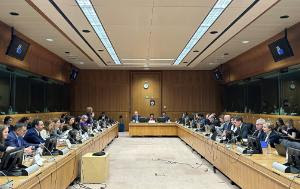
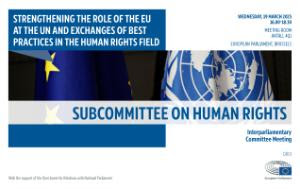
The European Parliament’s Subcommittee on Human Rights (DROI), in collaboration with the Legislative Dialogue Unit of the Directorate for Relations with National Parliaments, held an interparliamentary committee meeting with national parliaments on the topic: "Coordination between the EU and its Member States in Strengthening the EU’s Role at the UN and Exchanging Best Practices in the Human Rights Field." The meeting aimed to explore strategies for enhancing and supporting the EU's role at the UN level while facilitating the exchange of best practices in the field of human rights.
Source : © European Union, 2025 - EP | |
REPORT on the request for waiver of the immunity of Mariusz Kamiński Committee on Legal Affairs Mario Furore Source : © European Union, 2025 - EP | |
REPORT on the proposal for a directive of the European Parliament and of the Council amending Directive 2005/44/EC on harmonised river information services (RIS) on inland waterways in the Community Committee on Transport and Tourism Tom Berendsen Source : © European Union, 2025 - EP | |
DRAFT REPORT on the proposal for a regulation of the European Parliament and of the Council amending Regulations (EU) No 1024/2012 and (EU) 2018/1724 as regards certain requirements laid down by Directive (EU) XXXX/XXXX Committee on the Internal Market and Consumer Protection Adina Vălean Source : © European Union, 2025 - EP | |
DEVE Committee members will participate in the Nutrition for Growth Summit in Paris on 27 and 28 March to support the Team Europe efforts towards ending malnutrition. DEVE has consistently advocated to mobilize global action to support nutrition, promote food security and build resilient food systems and agriculture. Malnutrition is the leading cause of infant mortality worldwide and addressing it is key to SDG 2 to eradicate hunger and malnutrition. As part of the summit, DEVE Committee together with the Generation Nutrition Coalition organise a side event on Thursday 27 March from 19.00 at "Europa Expérience" focused on sustaining and strengthening responses to nutritional crises in fragile and conflict-affected settings. Members will discuss both the financial as well as political commitments that need to be sustained in the fight against malnutrition. Composition of the delegation: · Mr Barry Andrews DEVE Chair (Renew, IE) ; · Ms Leire Pajín (S&D, ES) · Ms Murielle Laurent (S&D, FR) · Mr Vlad Voiculescu (Renew, RO) Malnutrition is responsible for nearly one in two deaths among children under five. Malnutrition, in all its forms - undernutrition, deficiencies, overweight or obesity - is a major global challenge, affecting both developed and developing countries. |
DEVE Committee members will participate in the Nutrition for Growth Summit in Paris on 27 and 28 March to support the Team Europe efforts towards ending malnutrition. DEVE has consistently advocated to mobilize global action to support nutrition, promote food security and build resilient food systems and agriculture. Malnutrition is the leading cause of infant mortality worldwide and addressing it is key to SDG 2 to eradicate hunger and malnutrition. As part of the summit, DEVE Committee together with the Generation Nutrition Coalition organise a side event on Thursday 27 March from 19.00 at "Europa Expérience" focused on sustaining and strengthening responses to nutritional crises in fragile and conflict-affected settings. Members will discuss both the financial as well as political commitments that need to be sustained in the fight against malnutrition. Composition of the delegation: · Mr Barry Andrews DEVE Chair (Renew, IE) ; · Ms Leire Pajín (S&D, ES) · Ms Murielle Laurent (S&D, FR) · Mr Vlad Voiculescu (Renew, RO) Malnutrition is responsible for nearly one in two deaths among children under five. Malnutrition, in all its forms - undernutrition, deficiencies, overweight or obesity - is a major global challenge, affecting both developed and developing countries. |
REPORT on the request for waiver of the immunity of Mariusz Kamiński Committee on Legal Affairs Mario Furore Source : © European Union, 2025 - EP | |
Question for written answer E-001068/2025 to the Commission Rule 144 Ilaria Salis (The Left), Mimmo Lucano (The Left), Benedetta Scuderi (Verts/ALE), Cristina Guarda (Verts/ALE), Brando Benifei (S&D) Source : © European Union, 2025 - EP | |
Question for written answer E-001065/2025 to the Commission Rule 144 Lynn Boylan (The Left), Kathleen Funchion (The Left) Source : © European Union, 2025 - EP | |
AMENDMENTS 22 - 47 - Draft report Proposal for a regulation of the European Parliament and of the Council amending Regulation (EU) No 1026/2012 on certain measures for the purpose of the conservation of fish stocks in relation to countries allowing non-sustainable fishing Committee on Fisheries Thomas Bajada Source : © European Union, 2025 - EP | |
REPORT on the proposal for a directive of the European Parliament and of the Council amending Directive 2005/44/EC on harmonised river information services (RIS) on inland waterways in the Community Committee on Transport and Tourism Tom Berendsen Source : © European Union, 2025 - EP | |
| You are subscribed to Documents (FEMM) for European Parliament. This information has recently been updated, and is now available. | |
Gender mainstreaming is firmly established in Article 8 of the TFUE: "In all its activities, the Union shall aim to eliminate inequalities, and to promote equality, between men and women." Gender mainstreaming represents the integration of the gender perspective into every stage of policy processes with a view to promoting equality between women and men. As a monitoring tool, the FEMM committee draws up a regular report on gender mainstreaming in the work of the European Parliament. Source : © European Union, 2025 - EP |
|
| |
|