Σελίδες

Τρίτη 26 Σεπτεμβρίου 2023

IMF update


Dear MARIA,

We just published a new blog—please find the full text below. 

How Reform Can Aid Growth and Green Transition in Developing Economies

(Credit: Real Moment/Adobe Stock)

By Christian Ebeke and Florence Jaumotte

Many emerging market and developing economies face threats to economic growth and limited policy space due to high inflation, rising debt, and balance of payments pressures. These challenges mounted during the pandemic and were further intensified by Russia’s war in Ukraine.

Slower growth and constrained capacity to support their most vulnerable people expose some of these countries to substantial social instability risks. At the same time, these economies face the conundrum of participating in global efforts to reduce their carbon emissions and help combat climate change without sacrificing growth and jobs.

Amid such challenges, economy-wide reforms give policymakers the tools to foster growth and prepare for the green transition. As we show in a new staff discussion note, the gains from overhauling institutions and regulations for businesses and people—an enduring IMF recommendation for spurring growth—can quickly materialize even under severe economic strains, provided reforms are properly prioritized and sequenced. And these reforms are key to facilitate the decarbonization of economies.

Rapid output gains

Significant structural impediments continue to hinder growth in emerging market and developing economies. These stem from a range of issues, including weak governance, due to government ineffectiveness, political instability, and corruption. Reducing excessive regulation to make it easier for people to open and run a business is also one area with substantial room for improvement, particularly in low-income countries.

Limits on trade, notably through controls on foreign exchange, and to access to foreign capital are still prevalent in many countries. Additionally, restrictions in credit markets and labor markets contribute to these structural obstacles.

Our research shows that success hinges on how reforms are prioritized, sequenced, and bundled. Major changes addressing critical constraints to economic activity, such as reforms to improve governance and business regulation, and to reduce restrictions to trade and access to foreign capital, can deliver rapid output gains by promoting domestic and foreign investment and enhancing labor productivity. In economies with significant structural impediments, these so-called first-generation reforms can boost output levels by up to 4 percent in two years and up to 8 percent in four years. 

Historical examples, such as Georgia’s business regulation streamlining and fiscal reform in 2005 and Senegal’s comprehensive overhauls to improve governance, business regulation and external integration put in place in 2014-18, demonstrate the growth effects of such reforms. By frontloading these gains, well-designed reform packages could help overcome resistance to major changes and garner public support, including for the green transition.

Decarbonizing the economy

Given the extensive development needs of emerging market and developing economies, it is crucial that decarbonization efforts be accompanied by sustained economic growth.

The first-generation reforms are essential to generate growth and thereby support the green transition but also for facilitating the shift to low-carbon activities. Our research indicates that green policies, especially energy taxation, better decarbonize economies after first-generation broad reforms that make the economy more responsive to price signals.

Governance reforms can give the private sector more reason to steer capital toward green investments if they make government policy more predictable and signal that the authorities are more likely to follow through on the policy path that they have charted. They can also reduce implementation risks for climate projects, potentially attracting more financing from abroad. Reducing barriers to creating businesses will enable the private sector to invest more easily in new, green, emerging sectors. Lowering trade barriers can expand access to low-carbon technology and facilitate technology transfers that are critical for the green transition in less technologically advanced countries.

Nevertheless, first-generation reforms alone are not enough to support the green transition. Faster economic growth resulting from these reforms can increase emissions. While growth is essential, emerging market and developing economies must also reduce their carbon emissions over time.

Our research underscores that stringent green reforms, such as energy taxation, regulations, and green investments, are necessary to significantly reduce the emission intensity of economic activity. Combining first-generation and green reforms will enable these economies to reduce their overall emissions while supporting growth.

—This blog reflects research by Nina Budina, senior economist, European Department; Christian Ebeke, deputy division chief, Strategy, Review, and Policy Department; Florence Jaumotte, division chief, Research Department; Andrea Medici, research assistant, Research Department; Augustus Panton, economist, Research Department; Marina M. Tavares, economist, Research Department, and Bella Yao, research assistant, Strategy, Review, and Policy Department.

JeffCircle

Jeff Kearns

Managing Editor

IMF Blog

jkearns@IMF.org


Thank you again for your interest in IMF Blog.
Read more of our latest content here.

Take good care!


Dear MARIA,

In today's edition, we highlight:

  • Managing director at the UN
  • Fragile states
  • Financial supervision
  • Developing economies’ tax potential
  • Jordan’s Al-Ississ on progressive policies

UNITED NATIONS GENERAL ASSEMBLY

Growing Divergence Undermines Global Security

(Credit: IMF Photo)

A growing economic divergence between richer and poorer nations is a tragedy for people and also undermines global security, IMF Managing Director Kristalina Georgieva said in a social-media post at the end of the United Nations General Assembly Meeting in New York.

After three days of meetings with world leaders, Georgieva said in a video on X, formerly known as Twitter, that the world must mobilize more financing so countries have a chance to reach development goals.

Countries can raise revenue by curbing corruption and digitalizing taxes, but they also need support from the international community, including the IMF, the managing director said.

Since the pandemic, the Fund has played its part, including by injecting about a trillion dollars into the global economy through its largest-ever allocation of special drawing rights and through lending, Georgieva said. Innovative instruments such as the Resilience and Sustainability Trust are also helping, she added.

“There is so much more we can, and must, do for the world to be a prosperous place for its people.”

Special drawing rights are international reserve assets and used as the accounting unit for IMF transactions with member countries. In 2021 the IMF board of governors approved a new SDR allocation of $650 billion, the largest in the institution’s history. In this podcast, Ceyla Pazarbasioglu, who heads the Strategy, Policy and Review Department, says the SDR allocation will minimize the dangerous divergence in recovery paths around the world.

FRAGILE STATES

Fragile States Need Customized Support to Strengthen Institutions

(Credit: Abdulsalam Alturki/UNICEF)

Conflicts forcibly displaced a record 108.4 million people last year, many of them refugees hosted in neighboring countries where fiscal conditions are already tight and growth prospects are weak.

In a joint blog, four IMF department directors and one deputy director say that fragility and conflict drive fragmentation and can cause reversals in trade, capital flows, and investment. Supporting fragile states by strengthening economic and fiscal institutions is a global public good, as all countries can benefit, they add.

“Establishing and strengthening effective national institutions, or state-building, requires leadership, patience, and humility,” Tobias AdrianFranck BousquetDominique Desruelle, Vitor Gaspar and Bert Kroese say.

“The IMF is stepping up its capacity development to help countries address the complex and difficult challenges they are facing.”

Read Franck Bousquet’s article in the latest issue of F&D magazine on how to finance peace and stability, and the IMF’s strategy for fragile and conflict-affected states.


FINANCE & DEVELOPMENT

Jordan’s Progressive Fiscal Policies

(Credit: Courtesy of Ministry of Finance, Jordan)

Jordan’s deficits and debt are falling as a share of gross domestic product and the country’s most recent Eurobond sale was six times oversubscribed. Writing in the September issue of F&D magazine, Jordan’s Finance Minister Mohamad Al-Ississ explains how the government turned around its fiscal fortunes.

For policymakers, managing fiscal risk is not about neat mathematical equations or econometric models, Al-Ississ writes. “It is about the political economy of owning reforms and tailoring them to your country’s circumstances.”

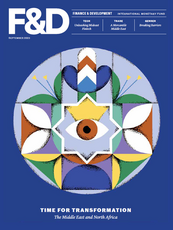
September cover

F&D magazine’s September issue, Time for Transformation, explores the choices confronting the politically and economically diverse nations of the Arab world.

Contributors include the IMF’s Jihad Azour on overhauling the Arab world’s economies, the Peterson Institute’s Adnan Mazarei on debt, Lebanon’s former economy minister Nasser Saidi on regional trade, Egypt’s minister of international cooperation Rania Al-Mashat on climate finance, Johns Hopkins University’s Vali Nasr on a generational shift in geopolitics, and many more.

Want to get a print copy delivered to your home or office?

Click for a free copy

FINANCIAL STABILITY

Financial Stability Needs Supervisors With Ability and Will to Act

(Credit: egon69/iStock by Getty Images)

Strong supervision is pivotal to keeping banks safe and sound, but supervisors in many countries face conditions that limit their effectiveness, Tobias Adrian, the director of the IMF’s Monetary and Capital Markets Department, writes in a blog.

Drawing on an IMF staff paper about lessons from recent bank turmoil in the United States and Switzerland as well as 10 years of surveillance and capacity building work, Adrian and co-authors say that progress on supervision has not been sufficient.

“Our findings show that more than half of the jurisdictions do not have independent bank supervisors with a clear safety and soundness mandate, with sound internal governance, or with resources appropriate to their assigned responsibilities.”

EMERGING MARKETS

Impact of interest rates

How have rising global interest rates impacted emerging markets? Watch our latest Analyze This! to find out.

TAX REFORM

Countries Can Tap Tax Potential to Finance Development Goals

(Credit: brunoat/iStock by Getty Images)

Emerging markets and developing economies could raise significantly more revenue with stronger tax systems and public institutions, IMF Fiscal Affairs Department Director Vitor Gaspar writes in a blog.

These countries need $3 trillion a year through 2030 to finance development and the climate transition. That amounts to about 7 percent of their combined gross domestic product and poses a formidable challenge, for low-income countries especially.

IMF research shows many countries have the potential to increase tax-to-GDP ratios—enabling them to provide critical government services—by as much as 9 percentage points.

“Countries have considerable room to collect more revenue based on their tax potential,” Gaspar and co-authors write.


DOMINICAN REPUBLIC

Income Convergence Signals Path to Advanced Economy Status

(Credit: Adobe Stock)

The Dominican Republic leads Latin America in narrowing the income gap with the United States and has the potential to become an advanced economy in the next 40 years, IMF economists write in a Country Focus article.

Despite being one of Latin America’s poorest countries in the mid-1960s, the Dominican Republic has seen its standard of living, as measured by per-capita income, rise to around one-third of that in the US. This stands in contrast to Latin America as a whole, where the average standard of living is around one-quarter of that in the US.

“This progress has impacted the average Dominican family, whose purchasing power has increased fourfold in the last 50 years, enabling them to enjoy a better quality of life and greater economic opportunities,” the authors say.


Weekly Roundup

DIGITAL CURRENCIES

New Fintech Research

Central banks around the world are at various stages of developing digital currencies. In a recent run of Fintech Notes, IMF economists explore various aspects of this fast-evolving area of finance, including how central banks should explore digital currency; the implications of central bank digital currencies for monetary policy; the design choices for central bank digital currencies; and a guide to central bank digital currency product development.

SOUTHEAST ASIA

Fragmentation Risks

Geoeconomic fragmentation could reverse some of Southeast Asia’s recent globalization gains. But in a staff paper, IMF economists say that further integration among the region’s five largest economies—Indonesia, Malaysia, the Philippines, Singapore and Thailand—could strengthen resilience against external shocks. There is scope to advance financial integration, which lags trade integration, and could generate sizeable output gains, the authors say.

TAX CUTS

Wining and Dining

Do temporary tax cuts stimulate consumer spending? Not according to a staff paper that investigates the impact of Lithuania’s decision to slash value-added tax on restaurant meals during the COVID-19 pandemic. “The VAT reduction has had no statistically significant impact on consumer spending on restaurants and catering services,” the author concludes, adding that restrictions on movement and other interventions were more important.

Thank you again very much for your interest in the Weekend Read! Be sure to let us know what issues and trends we should have on our radar.

nick

Nick Owen

Editor
IMF Weekend Read
nowen@IMF.org