Σελίδες

Τρίτη 2 Αυγούστου 2022

U.S.A.'s interesting latest news

header

The Treasury Inspector General for Tax Administration (TIGTA) today released the following:

Audit Report titled: Successful Detection and Assistance Processes Used to Combat Individual Identity Theft Should Be Implemented for Business Identity Theft.


Email Address: TIGTACommunications@tigta.treas.gov

Phone Number: 202-622-6500 

Website: http://www.tigta.gov

Note:  The difference between the date TIGTA issues an audit report to the Internal Revenue Service and the date TIGTA publicly releases the report is due to TIGTA's internal review process to ensure that public release is in compliance with Federal confidentiality laws.


This email was sent to politikimx@gmail.com using GovDelivery Communications Cloud on behalf of: Treasury Inspector General for Tax Administration · 901 D Street, SW, Suite 600 · Washington, D.C. 20024-2169 · (800) 366-4484GovDelivery logo

San Francisco & Chicago Districts 

3 Hour Virtual Workshop - Register today!

EEOC Priorities, LGBTQI+ Inclusion, Pandemic Accommodations 

Tuesday, August 16 at 9 a.m, PDT / 11 a.m. CDT / 12 p.m. EDT

Don't miss EEOC Vice Chair Jocelyn Samuels speaking on the Commission's top priorities, including LGBTQI+ issues and the civil rights impacts of the pandemic.  San Francisco District Director Nancy Sienko will open the program and Chicago District Director Julianne Bowman provides closing remarks, and EEOC experts lead workshops on Sexual Orientation and Gender Identity case law, LGBTQI+ inclusion and cultural competency, and workplace accommodations for disability and religion during COVID-19.

  • Opening Remarks | Nancy Sienko, San Francisco District Director
  • EEOC Priorities  | Jocelyn Samuels, EEOC Vice Chair
  • SOGI Legal Updates  | Jocelyn Samuels, EEOC Vice Chair;  Justin Mulaire, Chicago Supervisory Trial Attorney
    This session will examine case law on Sexual Orientation and Gender Identity (SOGI), highlighting significant decisions and implications for employees and employers.
  • LGBTQI+ Inclusion  | Zachary Florent, Outreach & Education Coordinator, Molly Powell, Seattle Administrative Judge
    How can you promote respectful, culturally competent interactions with LGBTQI+ colleagues and customers? Our experts review evolving language, pronoun use, and practices to make a workplace safe and welcoming for all. 
  • Pandemic Accommodations | Joyce Walker-Jones, Sr. Attorney Advisor Office of Legal Counsel     
    What lessons have we learned from responding and adapting to COVID-19? Join us for an update on the agency’s guidance on religious and reasonable accommodations.
  • Closing Remarks | Julianne Bowman, Chicago District Director    

REGISTRATION FEE: $150.00 per person

FULL AGENDA + BIOS:  EEOC 2022 Priorities, LGBTQI+ Inclusion and Pandemic Accommodations

ENROLL HEREChicago - San Francisco Virtual Workshop

CREDITS Update:

HRCI - This Program has been approved for 3.25 HR (General) recertification credit hours.

SHRM – Approved for 3 Professional Development Credits (PDCs) for SHRM-CP® or SHRM-SCP® recertification activities.

CLE – Oregon: approved for two General credits and one Access to Justice credit. Washington: approved for two Law & Legal credits and one Ethics credit. Pending credits for California, Iowa, Minnesota, North Dakota, and Wisconsin. Illinois CLE credits are not available for this program.

This Program has been approved for Federal Counselor or Investigator refresher credits.


Registered United States Census Bureau Logo

📆 The Week Ahead: Emergency Management

Today is Monday, August 1, and we are raising awareness of emergency management as parts of Kentucky have been overcome by floodwaters

August 1-7 is World Breastfeeding Week. Additionally, August is known for Back to School preparation. 

View our Stats for Stories page for more upcoming observances.

Last week, powerful floodwaters swallowed towns that hug creeks and streams in Appalachian valleys and hollows. The floods swamped homes and businesses, trashed vehicles, and crunched runaway equipment and debris against bridges. Search and rescue teams backed by the National Guard are searching for people missing in record floods that wiped out entire communities.

The U.S. Census Bureau produces timely local data that are critical to emergency planning, preparedness, and recovery efforts.

Learn More

You May Be Interested In

The U.S. Census Bureau, on July 28, released a report on how economic surveys captured the initial shock and resulting impact of the coronavirus pandemic, as well as economic trends since the national emergency was declared. 

The Coronavirus Pandemic’s Economic Impact brief uses data from the Quarterly Services Survey, Advance Monthly Retail Trade Survey, Monthly Wholesale Trade Survey, and Manufacturers’ Shipments, Inventories, and Orders Survey to gauge the pandemic’s impact on key economic sectors.

Explore

The U.S. Census Bureau, on July 27, released a new report, Occupations, Earnings, and Job Characteristics, that highlights the features of U.S. workers and their employment conditions. 

The report uses data from the 2018 Survey of Income and Program Participation (SIPP) and the 2018 American Community Survey (ACS) one-year estimates to describe workers’ occupations, schedule arrangements, median earnings and earnings arrangements, and coverage through employer-provided health insurance. The sample consists of the civilian, noninstitutionalized population age 16 or older working in at least one job.

Read More

🎂 Happy Birthday, Colorado!

Today, we are celebrating Colorado's 146th anniversary of statehood.

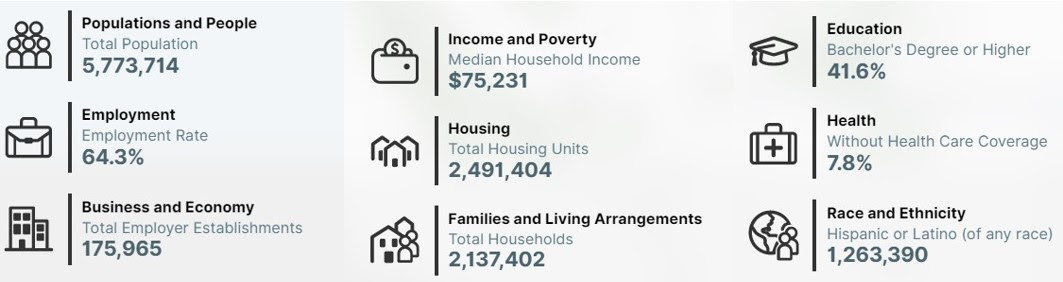
Colorado population and demographics

Did You Know?

  • Colorado joined the Union on August 1, 1876, as the 38th state.
  • Colorado's population increased by 744,518 from 2010-2020.
  • The state nickname is the Centennial State

💻 Upcoming Census Academy Webinars

More Upcoming Webinars

📅 Releases This Week

Monday: Construction Spending (Construction Put in Place)


Monday: August 2022: By the Numbers


Monday: America Counts: Wealth Inequality in the U.S. by Household Type


Tuesday: Housing Vacancies and Homeownership


Wednesday: Full Report - Manufacturers' Shipments, Inventories and Orders


Thursday: U.S. International Trade in Goods and Services


See Economic Indicators


News and Media Release

PBGC Approves Special Financial Assistance Application

GCIU Local 119B Plan to Receive SFA

FOR IMMEDIATE RELEASE
August 1, 2022

WASHINGTON, D.C. — The Pension Benefit Guaranty Corporation (PBGC) announced today that it has approved the application submitted to the Special Financial Assistance (SFA) Program by the Pension Plan of the Printers League - Graphic Communications International Union Local 119B (GCIU Local 119B Plan). The plan, based in East Farmingdale, New York, covers 1,213 participants in the printing industry.

The GCIU Local 119B Plan became insolvent in August 2021. At that time, PBGC started providing financial assistance to the plan. As required by law, the GCIU Local 119B Plan reduced participants’ benefits to the PBGC guarantee levels, which was roughly 31 percent below the benefits payable under the terms of the plan.

PBGC's approval of the SFA application enables the plan to restore benefit reductions caused by the plan’s insolvency and to make payments to retirees to cover prior benefit reductions. SFA will enable the plan to pay retirement benefits without reduction for many years into the future. The plan will receive $85.2 million in SFA, including interest to the expected date of payment to the plan.

"These 1,213 printers went to work with the promise of a pension when they retired. Today, the Biden-Harris Administration has fulfilled that promise," said U.S. Secretary of Labor Marty Walsh, chair of the Pension Benefit Guaranty Corporation Board of Directors. "Under President Biden's American Rescue Plan, the Pension Plan of the Printers League - Graphic Communications International Union Local 119B received Special Financial Assistance to deliver the pensions that these workers have earned."

This application was submitted and approved under PBGC's interim final rule. PBGC’s final rule, published last month, becomes effective on August 8.

About the Special Financial Assistance Program

The SFA Program was enacted as part of the American Rescue Plan Act of 2021 (ARP). The program provides funding to severely underfunded multiemployer pension plans and will ensure that millions of America’s workers, retirees, and their families receive the pension benefits they earned through many years of hard work.

The SFA Program requires plans to demonstrate eligibility for SFA and to calculate the amount of assistance pursuant to ARP and PBGC’s regulations. SFA and earnings thereon must be segregated from other plan assets and may be used only to pay plan benefits and administrative expenses. Plans are not obligated to repay SFA to PBGC. Plans receiving SFA are also subject to certain terms, conditions and reporting requirements, including for an annual statement documenting compliance with the terms and conditions. PBGC is authorized to conduct periodic audits of multiemployer plans that receive SFA.

The SFA Program is currently operating under an Interim Final Rule which was published in the Federal Register on July 12, 2021. Last month on July 8, 2022, PBGC published a Final Rule, which will become effective on August 8, 2022.

As of July 29, 2022, PBGC has approved over $7.4 billion to plans that cover over 149,000 workers and retirees.

About PBGC

PBGC protects the retirement security of over 33 million American workers, retirees, and beneficiaries in both single-employer and multiemployer private sector pension plans. The agency’s two insurance programs are legally separate and operationally and financially independent. PBGC is directly responsible for the benefits of more than 1.5 million participants and beneficiaries in failed pension plans. The Single-Employer Insurance Program is financed by insurance premiums, investment income, and assets and recoveries from failed single-employer plans. The Multiemployer Insurance Program is financed by insurance premiums. Special financial assistance for financially troubled multiemployer plans is financed by general taxpayer money.