Asset PurchasesPhoto: aldomurillo/iStock by Getty Images During the COVID crisis, central banks in emerging markets from Poland to the Philippines bought large sums of debt issued by their own governments to support their economies, without causing noticeable capital flight or exchange rate pressures. Should these asset purchases be viewed as an exceptional response to the COVID crisis, or could they become a more permanent addition to central banks’ policy options? The IMF’s Tobias Adrian, Christopher Erceg, Simon Gray, and Ratna Sahay answer this question in a new blog. While asset purchases can help central banks achieve their mandated objectives, they also pose significant risks, the authors say. --Balance sheet risks: One risk is to central banks’ own balance sheets: central banks can lose money if they buy sovereign or corporate debt when interest rates are low and then policy rates rise sharply. This may make a central bank less willing to tighten monetary policy. There is also a risk that governments grow accustomed to cheap financing and pressure central banks to continue, even if inflation rises. The resulting loss of confidence in a central bank’s ability to keep inflation low and stable could precipitate periods of high and volatile inflation.  Watch a recent IMF roundtable discussion on new monetary policy tools for emerging market and developing economies, where South African Reserve Bank Government Lesetja Kganyago, Bank of Russia Governor Elvira Nabiullina, and World Bank Chief Economist Carmen Reinhart underscored the risks. Watch a recent IMF roundtable discussion on new monetary policy tools for emerging market and developing economies, where South African Reserve Bank Government Lesetja Kganyago, Bank of Russia Governor Elvira Nabiullina, and World Bank Chief Economist Carmen Reinhart underscored the risks.
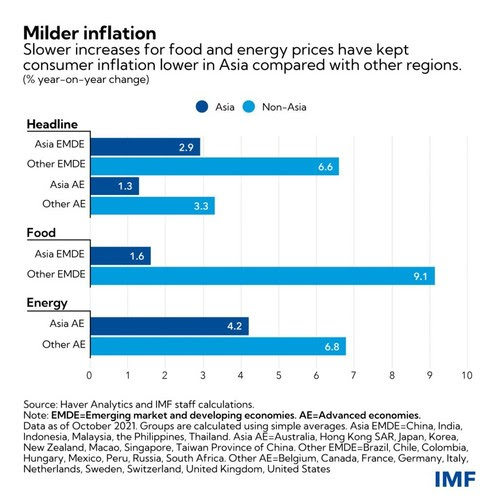
Inflation(Ljubaphoto/iStock by Getty Image) Price PressuresMinutes from the Federal Reserve’s most recent policy meeting published this week underscored the challenges facing central bankers as they seek to subdue inflation without snuffing out economic recovery. The IMF has warned for some time of the risks of inflation, including in this blog by Tobias Adrian and Chief Economist Gita Gopinath from December, in which the authors said it would be appropriate for the Federal Reserve to accelerate the taper of asset purchases and bring forward the path for policy rate increases. --Latin America: Annual inflation in the United States is now running at 6.8 percent, the fastest since 1982, but it is not the only economy grappling with fast-rising prices. In Latin America higher food prices have fueled inflation and led some central banks to raise interest rates early on in the recovery, as shown in this Chart of The Week. --Sub-Saharan Africa: In sub-Saharan Africa, too, the cost of food is a significant contributor to inflation, owing to a combination of higher oil prices, droughts, export restrictions imposed by some major food exporters, and stockpiling in some countries, as discussed here. --Asia: In Asia, meanwhile, inflationary pressures have so far been less pronounced than in other regions. But that could soon change, partly owing to higher shipping costs, as shown in this Chart of the Week. F&DArt: Sally Deng; iStock / Tamara Luiza How should economists measure growth and prosperity? In our most recent issue of Finance & Development magazine, Miles Kimball, Daniel Benjamin, Kristen Cooper and Ori Heffetz write about the principles that could define a new measure of economic prosperity beyond Gross Domestic Product to account for happiness and satisfaction. The recognition that GDP cannot encompass many dimensions of well-being has prompted efforts to develop measures that reflect a more complete account of what people care about. The idea is not to give up on GDP—nor to replace it with some other one-dimensional measure, such as self-reported life satisfaction, which, like GDP, gives only a partial and hence potentially misleading picture. Instead, a measure that captures many dimensions of national well-being and complements GDP is needed, they write. Want to get a print copy delivered to your home or office? Click here to subscribe. | 




 Listen to a