Σελίδες

Τετάρτη 5 Ιανουαρίου 2022

ΙΜF interesting latest news


Dear maria,

We just published a new blog—please find the full text below. 

Emerging-Market Central Bank Asset Purchases Can Be Effective but Carry Risks

image

By Tobias Adrian, Christopher ErcegSimon Gray, and Ratna Sahay

Asset purchases can be an effective tool, but it is critical to minimize risks to central bank independence and price stability.

Over the past couple of decades, central banks in emerging markets have made substantial progress in developing the credibility to conduct countercyclical monetary policy. During the COVID crisis, many of these central banks not only cut interest rates sharply, but also deployed a range of tools to help restore market functioning, including asset purchases. And, while some of these central banks now consider moves to tighter monetary policy stances, the likely use of these policy tools again in the future merits a closer look.

In previous years, it would have been mainly advanced economy central banks making purchases of government debt. However, for the first time on a significant scale, central banks in countries such as South Africa, Poland, and Thailand broke new ground through their use of asset purchases to combat market dysfunction.

While their actions were successful in reducing market stresses, policymakers in these and other emerging market and developing economies need to examine other important considerations as they chart a course forward.

Chief among these is whether asset purchases should be viewed as an exceptional response to the COVID crisis, or a more permanent addition their policy toolkits. At the same time, risks ranging from fiscal dominance and debt-monetization to excessive risk-taking need to be navigated.

These and other issues are discussed in detail in a recent IMF staff paper. Below, we summarize the findings and provide some preliminary guidance.

Asset purchases—useful tools that come with risks

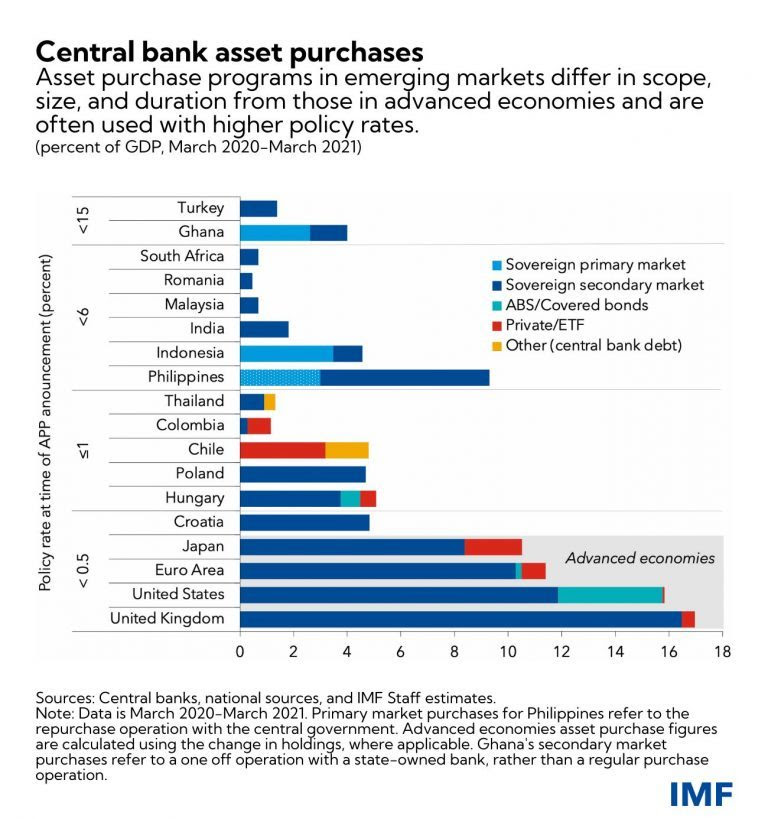
Central banks in many emerging market and developing economies have been reluctant to use asset purchases in past crises for fear of engendering a market backlash. As it turned out, targeted asset purchases in these countries during the COVID crisis helped reduce financial market stresses without precipitating noticeable capital outflow or exchange rate pressures.
chart

This overall positive experience suggests that these central banks will also consider asset purchases in future episodes of market turbulence, as discussed in a recent Global Financial Stability Report.

However, while asset purchases can help these central banks achieve their mandated objectives, they also pose significant risks.

One obvious risk is to the central banks’ own balance sheet: central banks can lose money if they buy sovereign or corporate debt when interest rates are low across maturities, and then policy interest rates rise sharply. A weaker balance sheet may make the central bank less willing or able to deliver on its mandated objectives when policy tightening is needed due to concerns that the required policy actions will hurt its own financial position.

A second risk is of “fiscal dominance,” whereby the government puts pressure on the central bank to pursue the government’s goals. Thus, while a central bank may initiate asset purchases—per its mandated objectives—it may find it hard to exit. The government may well grow accustomed to cheap financing from the central bank’s actions and pressure the central bank to continue, even if inflation rises and the price stability objective would call for ending the purchases. The resulting loss of confidence in a central bank’s ability to keep inflation low and stable could precipitate periods of high and volatile inflation.

At a recent IMF roundtable discussion on new monetary policy tools for emerging market and developing economies, Lesetja Kganyago (Governor, South African Reserve Bank), Elvira Nabiullina (Governor, Bank of Russia), and Carmen Reinhart (Chief Economist, World Bank Group) underscored the risks posed to central bank balance sheets and of fiscal dominance, but also drew attention to other unwelcome side effects. In particular, while asset purchases could reduce tail risks, such policies could have unintended effects such as encouraging excessive risk-taking and eroding market discipline. And a more active role for the central bank in market-making could inhibit financial market development.

Principles for asset purchases

Our recent asset purchases and direct financing paper provides some guiding principles aimed at harnessing the benefits of asset purchases while containing the risks. While we see scope for the use of these tools by central banks in emerging market and developing economies—including to help allay severe episodes of financial market distress—a strong and credible policy framework provides an essential foundation.

A core principle is that the central bank must have latitude to adjust its policy rate as needed to achieve its mandated objectives. This is critical. Central banks pay for the assets they buy through issuing reserves. These extra reserves could spawn large inflationary pressure unless the central bank can sterilize the reserves by raising its policy rate to a level consistent with price stability.

A closely related principle is that any purchases the central bank makes should be on its own initiative, and to achieve its mandated objectives (rather than those of the government). The size and duration of asset purchases should sync with those objectives: purchases undertaken for financial stability should generally be modest in scale and wound down when financial stresses ease, while those to provide macroeconomic stimulus may be larger and more persistent.

This principle can best be achieved by ensuring that central bank asset purchases are made in the secondary market, rather than “directly” through primary market purchases or an overdraft facility. Direct financing provides an easy route for the government to determine both the size of the central bank balance sheet and the interest rate that it will pay, tending to undermine fiscal discipline and to increase the risks of debt monetization.

Clear communication about both the objectives of asset purchase programs and the rationale for both entry and exit is also crucial.

Finally, our paper emphasizes the importance of a strong fiscal position. In particular, the government should be able to provide fiscal backing to cover any losses that may materialize. Such backing is needed to preserve the central bank’s financial autonomy, as well as to allow it to make policy decisions to achieve its mandate—rather than basing the decisions on concern about its (or the government’s) financial position. Moreover, the fiscal authority is more likely to resist the temptation to seek cheap financing from the central bank if its own position is strong.

While asset purchase programs may be relatively new territory for central banks in emerging market and developing economies, these principles should help provide a solid foundation.

image

Jeff Kearns

Managing Editor

IMF Blog

jkearns@IMF.org


Thank you again for your interest in IMF Blog.
Read more of our latest content here.

Take good care!


A broad-based economic recovery requires an end to the pandemic


(Photo: Dwayne Senior/Bloomberg via Getty Images)


Dear maria,

The pandemic has crystalized the inextricable link between human health and economic health. In our latest issue focused on global health and well-being, the IMF's Gita Gopinath and Ruchir Agarwal write about how a better collective effort to end the pandemic is necessary for a broad-based economic recovery.

Last year, Gopinath and Agarwal developed a detailed and comprehensive road map to end the COVID-19 pandemic, save lives, and put the world back on track toward economic recovery. In this article they provide an assessment of how far we've come and where need to go.

Read the full article below or on our website.

Check out our December Issue of Finance & Development

We also recently published a special series of articles that give a closer look at the issues critical for the development of sub-Saharan Africa.


Last May, the IMF released a detailed and comprehensive road map to end the COVID-19 pandemic, save lives, and put the world back on track toward a broad-based economic recovery ("A Proposal to End the COVID-19 Pandemic," Agarwal and Gopinath, 2021). The road map was endorsed by multilateral institutions and key stakeholders. It was based on a simple, yet powerful premise: Ending the pandemic is a necessary prerequisite to restoring jobs, livelihoods, and economic well-being. One cannot be achieved without the other. 

How has the world fared since the release of the road map? The global recovery has continued, but momentum has weakened. In six months, the officially recorded global COVID-19 death toll has risen by about 50 percent and is now over 5 million, and the actual death toll is estimated to be several times higher. Of particular concern is the growing divergence in economic prospects between rich and poor nations. In the October 2021 World Economic Outlook, the IMF projected that aggregate output for advanced economies would regain its pre-pandemic trend path in 2022 and exceed it by 0.9 percent in 2024. By contrast, output for emerging market and developing economies, excluding China, is expected to remain 5.5 percent below the pre-pandemic forecast in 2024.

This divergence in economic prospects is a consequence of wide disparities in vaccination rates (which we call “the great vaccine divide”) and policy support. As of the end of October, among advanced economies, about 65 percent of the population was fully vaccinated, and booster shots were available in many of them. By contrast, the vaccination rate was less than 2 percent among low-income countries. This is not just a problem for particular countries or regions, it is a global problem. As public health officials have stressed repeatedly, the pandemic is not over anywhere until it is over everywhere. Further unchecked transmission makes the emergence of new variants—including some that are resistant to existing vaccines—more likely, possibly putting the world back at the starting line in the race against the virus. If COVID-19 were to have a prolonged impact, we could see global GDP losses rise to $5.3 trillion over five years relative to our current projection, with several million more lives lost.

Action plan

Our road map identified three broad targets and actions needed to meet those targets, as well as financing needs for each action. The targets: vaccinating at least 40 percent of the population in all countries by the end of 2021 and 70 percent by the first half of 2022; tracking and insuring against downside risks (due to the rise of new variants or supply-chain problems); and saving lives by ensuring widespread access to tests, treatments, personal protective equipment, and other critical health tools. 

Progress toward the key actions needed to achieve those targets has been mixed, and we are still behind. As of the end of October, some 75 to 80 nations, mostly in Africa, were not on track to meet the end-2021 40 percent vaccination target. Fifty-five of these countries will likely have problems primarily with supply, whereas 24 will have both supply and absorption-capacity issues. 

Our plan recommends the following near-term actions to end the pandemic and support a broad-based economic recovery.

Immediately closing the 550 million dose gap to achieve 40 percent coverage by accelerating existing dose donations to the COVID-19 Vaccines Global Access (COVAX) facility, an initiative aimed at equitable distribution of vaccines, and pledging new donations; executing dose swaps with COVAX and the African Union (that is, deferring the delivery of doses intended for Group of Twenty [G20] countries to allow developing economies to move up in the queue); and eliminating restrictions on exports of vaccines and critical inputs. 

Committing to financing the new ACT-Accelerator budget of about $23 billion to ensure that all countries can access the necessary volume of vaccines, tests, treatments, and personal protective equipment. (The ACT-Accelerator is a partnership of the world’s international health organizations to fight COVID-19.)

Maintaining collective accountability of progress against the targets through frequent engagement between Group of Seven advanced economies, the broader G20, and other key stakeholders.

Beyond the near term, it will be important to expand regional manufacturing capacity of vaccines in developing economies and monitor risks. 

Better stewardship

After nearly two years of the deadliest and most economically devastating pandemic in a century, what are the initial lessons we have learned? 

First, the COVID-19 crisis has made it clear that pandemic policy is economic policy, that there is no durable end to the economic crisis without an end to the health crisis. Ending the pandemic is therefore critical for global macroeconomic and financial stability, which makes it of fundamental importance to the IMF and other economic institutions. Indeed, the IMF’s projections and policy recommendations for the global economy rely crucially on the relative success of the race against the virus. Systemic risks posed by future pandemics and global health concerns should be more explicitly accounted for in economic analysis and surveillance.

Second, the world needs better stewardship of global public goods, including preparedness to fight future pandemics. This will require much greater coordination and collective action than we have managed to summon so far. The G20 High Level Independent Panel’s report on pandemic preparedness provides several concrete steps in this regard (see “Rethinking Multilateralism for a Pandemic Era,” this issue).

We are all in this fight together, and collectively we can and must do better to fight the problems facing the planet. 

authors


Have Your Say

What do you think of this article? Please write to us directly and let us know your thoughts. We would love to hear from you.

Adam circle

Adam Behsudi

Senior Editor

F&D Magazine

abehsudi@IMF.org

 
International Monetary Fund