ΑΞΙΟΠΙΣΤΕΣ, ΟΛΟΚΛΗΡΩΜΕΝΕΣ, ΔΟΚΙΜΑΣΜΕΝΕΣ ΣΤΟ ΧΡΟΝΟ ΓΙΑ ΤΗΝ ΑΝΤΙΚΕΙΜΕΝΙΚΟΤΗΤΑ ΤΟΥΣ ειδήσεις...ΓΙΑ ΟΣΑ ΣΥΜΒΑΙΝΟΥΝ ΣΤΟΝ ΔΗΜΟ ΑΧΑΡΝΩΝ!

Toπικό Μέσο Μαζικής ενημέρωσης ("θυγατρικό" της "ΠΟΛΙΤΙΚΗ"),ΜΙΑ ΚΡΑΥΓΗ ΠΡΟΣ ΤΗΝ ΕΛΛΗΝΙΚΗ ΔΙΚΑΙΟΣΥΝΗ 170.000 Ελλήνων Πολιτών. Είκοσι πέντε ολόκληρα χρόνια ζωής (2000-2025) και αγώνων στην καταγραφή και υπεράσπιση της Αλήθειας για τον πολύπαθο τόπο των Αχαρνών.

2000 - 2025

2000-2025 - ΕΙΚΟΣΙ ΠΕΝΤΕ ΟΛΟΚΛΗΡΑ ΧΡΟΝΙΑ...ΟΥΤΕ ΜΙΑ ΔΙΑΨΕΥΣΙΣ!!

"ΠΟΛΙΤΙΚΗ 2000-2025"

Διαβάζετε ένα ΑΠΟΛΥΤΩΣ ΑΞΙΟΠΙΣΤΟ και ΧΩΡΙΣ ΚΑΜΙΑ ΑΠΟΛΥΤΩΣ οικονομική στήριξη (αυτοδιοικητική, χορηγική, δημοσία ή άλλη ) ηλικίας 25 ετών Μέσο Μαζικής Ενημέρωσης, με αξιοσημείωτη ΔΙΕΘΝΗ αναγνώριση και ΕΞΑΙΡΕΤΙΚΑ ΥΨΗΛΗ ΑΝΑΓΝΩΣΙΜΟΤΗΤΑ.
Είκοσι πέντε (25) ολόκληρα χρόνια δημοσιογραφίας, ΟΥΤΕ ΜΙΑ ΔΙΑΨΕΥΣΙΣ!!
Contact: politikimx@gmail.com v.ch.maria@gmail.com
Ενδεικτική αναφορά αναγνωσιμότητος είναι:
76762 (Ioυλιος 2025..λέει η γκούγκλ)
80410 (Aύγουστος 2025..είπαμε.."λέει η γκούγκλ”)
87122 (Οκτώβριος 2025) 
104589 (Νοέμβριος 2025) 

Αναζήτηση αυτού του ιστολογίου

Ε.Ε.:Νέος Κανονισμός για την Αποψίλωση (EUDR - 2025) ..-ΝΟΜΙΚΗ ΒΙΒΛΙΟΘΗΚΗ, ενημέρωση..- ΠΑ.ΣΟ.Κ. ενημέρωση..-Άρθρο Κωνσταντίνου Γάτσιου, Τομεάρχη Ανάπτυξης του ΠΑΣΟΚ-Κινήματος Αλλαγής στην ηλεκτρονική εφημερίδα «Οικονομικός Ταχυδρόμος» (16/12)..-COUNCIL OF THE EUROPEAN UNION,update..-"ΕΛΕΥΘΕΡΟΣ ΤΥΠΟΣ" Ειδήσεις..-Πρωθυπουργού Κυριάκου Μητσοτάκη δηλώσεις μετά το πέρας των εργασιών του Ευρωπαϊκού Συμβουλίου στις Βρυξέλλες..-Prime Minister Carney....-NASA's wonderful world!!..-"δρόμος ΤΗΣ ΑΡΙΣΤΕΡΑΣ" Ειδήσεις..-ASEP NEWSLETTER..- BATA SHOE MUSEUM.....-MAΡΙΑΣ ΑΝΑΡΤΗΣΕΙΣ ΣΤΑ SOCIAL MEDIA..-Ο Πρόεδρος της Κυπριακής Δημοκρατίας βρέθηκε στο Παρίσι 15 Δεκεμβρίου για να συναντηθεί με τον Εμανουέλ Μακρόν..- Πρωθυπουργού Κυριάκου Μητσοτάκη δηλώσεις μετά το πέρας των εργασιών του Ευρωπαϊκού Συμβουλίου στις Βρυξέλλες..-"ΤΟ ΒΗΜΑ" Ειδήσεις..-"ΕΛΕΥΘΕΡΟΣ ΤΥΠΟΣ" Ειδήσες..-Prime Minister, Mark Carney,..-USDA Foreign Agricultural Service..-EU Meat Market Observatory..-American Apparel & Footwear Association,update..-IΔΡΥΜΑ ΕΥΓΕΝΙΔΟΥ, ενημέρωση..-INTERNATIONAL LEATHER MAKER,update..-BOARD OF GOVERNORS OF THE FERERAL RESERVE SYSTEM,U.S.A's news,update..-OBAMA's newest..-NATO news..-COUNCIL OF THE EUROPEAN UNION,update..-© 2025 The National Herald..-AHEPA latest..-ΧΩΡΙΣ ΤΙΤΛΟ γιατί με δυσκολεύει πολύ.....-Archipelagos Institute of Marine Conservation,update..-ΕΛΛΗΝΙΚΗΣ ΚΥΒΕΡΝΗΣΕΩΣ ενημέρωση απο τον Κυβερνητικό Εκπρόσωπο κ. Μαρινάκη..-Πρωθυπουργού Κυριάκου Μητσοτάκη δηλώσεις,κατά την άφιξή του στο Ευρωπαϊκό Συμβούλιο, στις Βρυξέλλες..-ΕΕΑ επιχειρηματική ενημέρωση..-Ολομέλεια Διοίκησης της ΓΣΕΕ: «Αφετηρία αγώνων και όχι τερματισμός η συμφωνία για τις συλλογικές συμβάσεις»..-EUROPEAN PUBLIC PROSECUTOR's OFFICE,ΔΙΚΑΙΟΣΥΝΗ,update..-"ΤΟ ΒΗΜΑ" Ειδήσεις..-"ΕΛΕΥΘΕΡΟΣ ΤΥΠΟΣ" Ειδήσεις..-"ΜΑΚΕΔΟΝΙΑ" Ειδήσεις..-AGRICULTURE AND RURAL DEVELOPMENT..- European Bank for Reconstruction and Development ..update..-COUNCIL OF THE EUROPEAN UNION,update..-ΕΘΝΙΚΗ ΑΡΧΗ ΔΙΑΦΑΝΕΙΑΣ:webinar..-MAΡΙΑΣ ΑΝΑΡΤΗΣΕΙΣ ΣΤΑ SOCIAL MEDIA..-ASIA- PACIFIC ECONOMIC COOPERATION APEC:update..-Ελεύθερα στο διαδίκτυο το ντοκιμαντέρ «Οι Επικηρυγμένοι» για την επανεμφάνιση του λύκου στην Αττική..-Φυγαδεύτηκε από τη Γαλλία ο ευρωβουλευτής Νίκος Παππάς..-Πρωτοβουλία για τη Διασφάλιση της Δημόσιας Διαχείρισης του Νερού: Συνέντευξη Τύπου με αντικείμενο τη λειψυδρία και τον δημόσιο χαρακτήρα του νερού..-Άγριο επεισόδιο ξυλοδαρμού δημοσιογράφου στο Στρασβούργο από τον ευρωβουλευτή ΣΥΡΙΖΑ Νίκο Παππά: ....-ΕΝΥΠΕΚΚ ενημέρωση..-Dassana's Veg Recipes..-NASA's Earth Observatory,update..-ΛΕΣΧΗ ΣΥΖΗΤΗΣΕΩΝ ΔΗΜΟΤΩΝ ΑΧΑΡΝΩΝ:παρατίθεται αιτηθείσα πληροφόρηση μελών..-AGRICULTURE AND RURAL DEVELOPMENT,update..-ΕΒΕΑ επιχειρηματική ενημέρωση..-European Art Center and Institute for Eastern Roman Empire Research Studies in Europe:update..-ΠΑΝΑΓΙΩΤΗ ΓΕΡΟΓΛΗ,ΣΤΡΑΤΗΓΟΥ ε.α. ΕΚΠΛΗΚΤΙΚΟ ΚΕΙΜΕΝΟ..-Πανελλήνια Ομοσπονδία Φοροτεχνικών Ελευθέρων Επαγγελματιών (Π.Ο.Φ.Ε.Ε.):WEBINAR..-MAΡΙΑΣ ΑΝΑΡΤΗΣΕΙΣ ΣΤΑ SOCIAL MEDIA..-THE EUROPEAN FOOD INFORMATION COUNCIL EUFIC:"OΣΠΡΙΑ ερωτήσεις και απαντήσεις.....-"ΕΛΕΥΘΕΡΟΣ ΤΥΠΟΣ" Ειδήσεις..- Ομιλία του Πρωθυπουργού Κυριάκου Μητσοτάκη στη Βουλή, στη συζήτηση για κύρωση Κρατικού Προϋπολογισμού 2026..-ΚΥΡΙΑΚΟΥ ΜΗΤΣΟΤΑΚΗ,ΠΡΩΘΥΠΟΥΡΓΟΥ ΤΗΣ ΕΛΛΑΔΟΣ,πρόσφατη ενημέρωση..-Prime Minister Carney..-WTO update..-AGRICULTURE AND RURAL DEVELOPMENT:Agricultural outlook newsletter..-WORLD HEALTH ORGANIZATION,update..-Νέα από το «Ξεκίνημα»..-"ΤΟ ΒΗΜΑ" Ειδήσεις..-Κέντρον Ερεύνης Ελληνικής Λαογραφίας Ακαδημίας Αθηνών:εθιμολογία της περιόδου του Δωδεκαημέρου..- "Γιατί η Κοινωνία Επιβραβεύει τη Συλλογική Αποχαύνωση και Απορρίπτει την Κριτική Σκέψη ?"..-DASSANA'S VEG RECIPES.....-EUROPEAN PARLIAMENT update..-ΑΡΧΗ ΠΡΟΣΤΑΣΙΑΣ ΔΕΔΟΜΕΝΩΝ..."save the date"..-ΝΙΚΟΛΑΟΥ ΔΕΝΔΙΑ, ΥΠΟΥΡΓΟΥ ΕΘΝΙΚΗΣ ΑΜΥΝΗΣ πρόσφατη ενημέρωση..- ΔΗΜΗΤΡΙΟΥ ΠΑΠΑΣΤΕΡΓΙΟΥ,ΥΠΟΥΡΓΟΥ ΨΗΦ.ΔΙΑΚΥΒΕΡΝΗΣΗΣ, πρόσφατη ενημέρωση..-ΚΥΡΙΑΚΟΥ ΠΙΕΡΡΑΚΑΚΗ,ΥΠΟΥΡΓΟΥ ΕΘ.ΟΙΚΟΝΟΜΙΑΣ ΚΑΙ ΠΡΟΕΔΡΟΥ EUROGROUP,Ομιλία στην Ολομέλεια της Βουλής για τον Προϋπολογισμό 2026..-ΚΩΣΤΗ ΧΑΤΖΗΔΑΚΗ,ΑΝΤΙΠΡΟΕΔΡΟΥ ΤΗΣ ΕΛΛΗΝΙΚΗΣ ΚΥΒΕΡΝΗΣΕΩΣ πρόσφατη ενημέρωση,..-ΠΑ.ΣΟ.Κ. ενημέρωση,..-ΕΛΛΗΝΙΚΗΣ ΚΥΒΕΡΝΗΣΕΩΣ ενημέρωση απο τον Κυβερνητικό Εκπρόσωπο κ. Μαρινάκη..-" ΤΟ ΒΗΜΑ" Ειδήσεις..-"ΕΛΕΥΘΕΡΟΣ ΤΥΠΟΣ" Ειδήσεις..-"ΜΑΚΕΔΟΝΙΑ" Ειδήσεις..-ΕUROPEAN FOOTWEAR CONFEDERATION's update..-INTERNATIONAL LEATHER MAKER,update..-WORLD FOOTWEAR,update..-THE OBAMA's news..- Ινστιτούτο Θαλάσσιας Προστασίας “Αρχιπέλαγος”,ενημέρωση..-American Enterprise Institute for Public Policy Research :update..-"ΑΧΑΡΝΕΣ: η στυγνή δολοφονία των πολύ μικρών επιχειρήσεων":..-GSA update..-ΒΟΥΛΗΣ ΤΩΝ ΕΛΛΗΝΩΝ Νομοθετικό έργο..-COUNCIL OF THE EUROPEAN UNION,update..-ΕΝΙ ΕΟΠΥΥ Αναγκαία η ουσιαστική αναπροσαρμογή των αμοιβών των ιατρών του ΕΟΠΥΥ..- ..- --

ΝΙΚΟΛΑΟΥ ΜΕΣΟΓΑΙΑΣ,ΜΗΤΡΟΠΟΛΙΤΟΥ, Συνέντευξις που πρέπει να παρακολουθήσουμε ΟΛΟΙ

MHN ΞΕΧΝΑΤΕ ΝΑ ΔΙΑΒΑΖΕΤΕ ΚΑΙ ΕΔΩ:

SELECT LANGUAGE


6/12/2025 ώρα 10.13', 1.622 ΑΝΑΓΝΩΣΕΙΣ.Παρέμβαση counter το μετατρέπει σε ...984 (!!!) ώρα 10.13'
Η "ΠΟΛΙΤΙΚΗ 2000-2025" πολεμιέται απο της γέννησής της.Αντί να εξαφανιστεί, μετετράπει στον χειρότερο εφιάλτη των δολοφόνων της-πάσης..προέλευσης-με μια πρωτόφαντη αναγνωσιμότητα εξαίρετα νοημόνων Αναγνωστών οι οποίοι την στήριξαν και την στηρίζουν ως ΜΕΣΟΝ ΔΙΑΦΟΡΦΩΣΗ ΓΝΩΜΗΣ.
Είναι ένα Μέσο τόσο ειλικρινές, ανιδιοτελές και ΕΝΤΙΜΟ που αποδεικνύει περιτράνως εδώ και ένα τέταρτο αιώνα πως "ΟΙ ΑΞΙΕΣ ΠΟΤΕ ΔΕΝ ΧΑΝΟΝΤΑΙ".
Η τεχνογνωσία και η προσφορά ψυχής...ΔΕΝ ΠΟΛΕΜΙΕΤΑΙ.
Που θα πάει;;Θα το εμπεδώσετε αλλά καταλαβαίνω: μέχρι να κάνει το ερέθισμα την διαδρομή αυτιού-ματιού-κέντρο εγκεφάλου σας..ΧΡΕΙΑΖΟΝΤΑΙ ΚΑΙ ΚΑΠΟΙΑ...ΧΡΟΝΙΑ!!!(ζητήστε να σας..το μεταφράσει ένας αναγνώστης μας γιατί είμαι βεβαία πως ΔΕΝ ΜΠΟΡΕΙΤΕ ΝΑ ΑΝΤΙΛΗΦΘΕΙΤΕ Τ Ι Ε Ν Ν Ο Ω στην τελευταία μου παράγραφο!!) "ΠΕΡΑΣΤΙΚΑ ΣΑΣ..."

ΣΤΟΧΕΥΜΕΝΗ ΑΝΑΦΟΡΑ ΜΕΙΩΣΗΣ ΑΝΑΓΝΩΣΙΜΟΤΗΤΟΣ

6/12/2025 ώρα 10.13', 1.622 ΑΝΑΓΝΩΣΕΙΣ.Παρέμβαση counter το μετατρέπει σε ...984 (!!!) ώρα 10.13'

ΕΜΠΡΑΚΤΗ ΣΥΜΠΑΡΑΣΤΑΣΗ ΣΤΑ ΑΔΕΛΦΙΑ ΜΑΣ

Μια αδελφική ΠΑΡΑΙΝΕΣΗ:Βοηθήστε τους Αγρότες με δύο τρόπους:ένα μπιτόνι ΠΕΤΡΕΛΑΙΟ για ένα τρακτέρ ή δέκα σαντουϊτς (αν και αυτοί είναι ΟΛΟΙ ΝΟΙΚΟΚΥΡΗΔΕΣ και δεν το έχουν ανάγκη) είναι η συμμετοχή όσων δεν μπορούμε να είμαστε μαζί τους στα μπλόκα.Είναι η ΔΙΚΗ ΜΑΣ φτωχή ΣΥΜΠΑΡΑΣΤΑΣΗ χωρίς λόγια...αλλά με έργα. ΕΡΓΑ μόνο ΕΜΕΙΣ ΟΙ ΦΤΩΧΟΙ ΕΛΛΗΝΕΣ μπορούμε να ΠΡΑΤΤΟΥΜΕ. ΣΥΜΠΑΡΑΣΤΑΣΗ ΣΤΑ ΑΔΕΛΦΙΑ ΜΑΣ....

ΓΕΩΡΓΙΟΥ Θ.ΒΛΑΧΟΥ,ΒΟΥΛΕΥΤΟΥ Ν.Δ. ΑΝ. ΑΤΤΙΚΗΣ, ΘΕΡΜΕΣ ΕΥΧΕΣ

ΓΕΩΡΓΙΟΥ Θ.ΒΛΑΧΟΥ,ΒΟΥΛΕΥΤΟΥ Ν.Δ. ΑΝ. ΑΤΤΙΚΗΣ, ΘΕΡΜΕΣ ΕΥΧΕΣ

ΑΡΧΗ ΠΡΟΣΤΑΣΙΑΣ ΔΕΔΟΜΕΝΩΝ:Θερμές ευχές για χαρούμενες γιορτές και μια καινούργια χρονιά γεμάτη υγεία

ΑΡΧΗ ΠΡΟΣΤΑΣΙΑΣ ΔΕΔΟΜΕΝΩΝ:Θερμές ευχές για χαρούμενες γιορτές και μια καινούργια χρονιά γεμάτη υγεία
ΑΡΧΗ ΠΡΟΣΤΑΣΙΑΣ ΔΕΔΟΜΕΝΩΝ:Θερμές ευχές για χαρούμενες γιορτές και μια καινούργια χρονιά γεμάτη υγεία και δημιουργικότητα!

Το Κέντρον Ερεύνης της Ελληνικής Λαογραφίας της Ακαδημίας Αθηνών σας εύχεται καλά Χριστούγεννα και ευτυχισμένο το νέον έτος 2026!

ΓΙΟΡΤΗ ΚΑΙ ΕΥΧΕΣ ΒΑΣΙΛΗ ΟΙΚΟΝΟΜΟΥ - ΒΟΥΛΕΥΤΗ ΝΔ ΑΝΑΤ. ΑΤΤΙΚΗΣ

ΓΣΕΕ Ευχές

ΓΣΕΕ Ευχές
ΓΣΕΕ ΓΕΝΙΚΗΣ ΣΥΝΟΜΟΣΠΟΝΔΙΑΣ ΕΡΓΑΤΩΝ ΕΛΛΑΔΟΣ, θερμές Χριστουγεννιάτικες Ευχές

Ένωση Εργαζομένων Καταναλωτών Ελλάδας:θερμές Χριστουγεννιάτικες Ευχές

Ένωση Εργαζομένων Καταναλωτών Ελλάδας:θερμές Χριστουγεννιάτικες Ευχές

ΕΝΩΣΗ ΞΕΝΟΔΟΧΩΝ ΑΘΗΝΩΝ-ΑΤΤΙΚΗΣ & ΑΡΓΟΣΑΡΩΝΙΚΟΥ :Χριστουγεννιάτικες Ευχές

ΕΝΩΣΗ ΞΕΝΟΔΟΧΩΝ ΑΘΗΝΩΝ-ΑΤΤΙΚΗΣ & ΑΡΓΟΣΑΡΩΝΙΚΟΥ :Χριστουγεννιάτικες Ευχές

Περιφερειακό Παρατηρητήριο Κοινωνικής Ένταξης Περιφέρειας Κρήτης θερμές Ευχές

Περιφερειακό Παρατηρητήριο Κοινωνικής Ένταξης Περιφέρειας Κρήτης θερμές Ευχές

ΣΕΒ σύνδεσμος επιχειρήσεων και βιομηχανιών Θερμές Ευχές

ΣΕΒ σύνδεσμος επιχειρήσεων και βιομηχανιών Θερμές Ευχές

Καλά Χριστούγεννα & Καλή Χρονιά! ΝΤΟΡΑ ΜΠΑΚΟΓΙΑΝΝΗ

Καλά Χριστούγεννα & Καλή Χρονιά! ΝΤΟΡΑ ΜΠΑΚΟΓΙΑΝΝΗ

American Apparel & Footwear Association "Happy Holidays"!!

American Apparel & Footwear Association "Happy Holidays"!!

Ε.Ε.Φα.Μ Θερμές Ευχές

Ε.Ε.Φα.Μ Θερμές Ευχές

Κυριακή 18 Απριλίου 2021

IMF interesting latest news


The latest IMF analysis of global economics, finance, development and policy issues shaping the world //


IMF Weekend Read

Dear maria,

In today's edition we focus on Regional Economic Outlooks for Asia and the Pacific, the Middle East and Central Asia, Latin America and the Caribbean, sub-Saharan Africa, and Europe; the economic benefits of fighting climate change; digital money and remittances; accountability and transparency in government finances; and the urgency of a green recovery; among other things. On that note, let's dive right in.

EXTERNAL THREATS TO ASIA'S RECOVERY

In some Asia-Pacific countries, the unpleasant memory of the pandemic is receding; elsewhere, second or third waves of infections are raging. A recovery is underway, but the regional averages obscure wide differences within and across countries. In the latest outlook for Asia and the Pacific growth is expected to rebound to 7.6 percent this year and 5.4 percent next year.

Spillover effects: new blog by the IMF's Jonathan Ostry explores how the external factors is the central driver of risk in the region, due to Asia's outward orientation to trade and capital flows. Asia is likely to experience favorable spillovers through trade channels as US fiscal expansion boosts growth and imports—that’s the good news for the region. But if US yields rise faster than markets expect, or if there is miscommunication about future US monetary policy, adverse spillovers through financial channels and capital outflows, as during the 2013 taper tantrum, could compromise macrofinancial stability.

Read the blog📺 Watch the press briefing or read the transcript.

THE MIDDLE EAST'S LONG AND DIVERGENT RECOVERY

A year into the pandemic, growth is expected to pick up in the region but the path to recovery is still long, divergent, and depends on vaccination rollouts and policy space. Saving lives and livelihoods remains policymakers’ top priority. The new Regional Economic Outlook for the region notes that accelerating vaccination would boost GDP by 1 percent by 2022. But the recovery largely depends on the COVID-19 vaccine rollout, and there is significant variation in its distribution among countries. For example, the rollout is well underway in some Gulf Cooperation Council countries and Morocco, but others, especially low-income countries, may not achieve full vaccine coverage until 2023. This, along with the uncertain trajectory of the pandemic, could affect the economic outlook and delay the recovery.

Divergent Recoveries: Fragile and conflict-affected states face a particularly steep path ahead, a result of the slow vaccine rollout, limited policy support, and significant political, economic, security, and social instability. In addition, tourism-dependent economies revised their GDP projections down for 2021, with the long-lasting impact of the crisis expected on these economies. Meanwhile, oil prices are recovering to their pre-crisis levels. With better access to vaccines and more policy space, the outlook for oil exporters is improving, although production cuts will weigh on oil GDP for some time. Finally, countries that implemented strong fiscal support when COVID-19 first hit are expected to recover to pre-pandemic GDP levels this year. For others, the recovery may take longer. Securing access to vaccines and supporting health systems will be key. Vaccine policy is economic policy, and regional and international cooperation can play a vital role in this endeavor.

Read the full report, review the key messages, read the press remarks, and watch the press briefing or read the transcript.

📺 You can also watch an in-depth discussion about recovery challenges and opportunities focused on the Middle East and North Africa, and another discussion on similar topics focused on the Caucasus and Central Asia.

LATIN AMERICA STILL IN THE EYE OF THE STORM

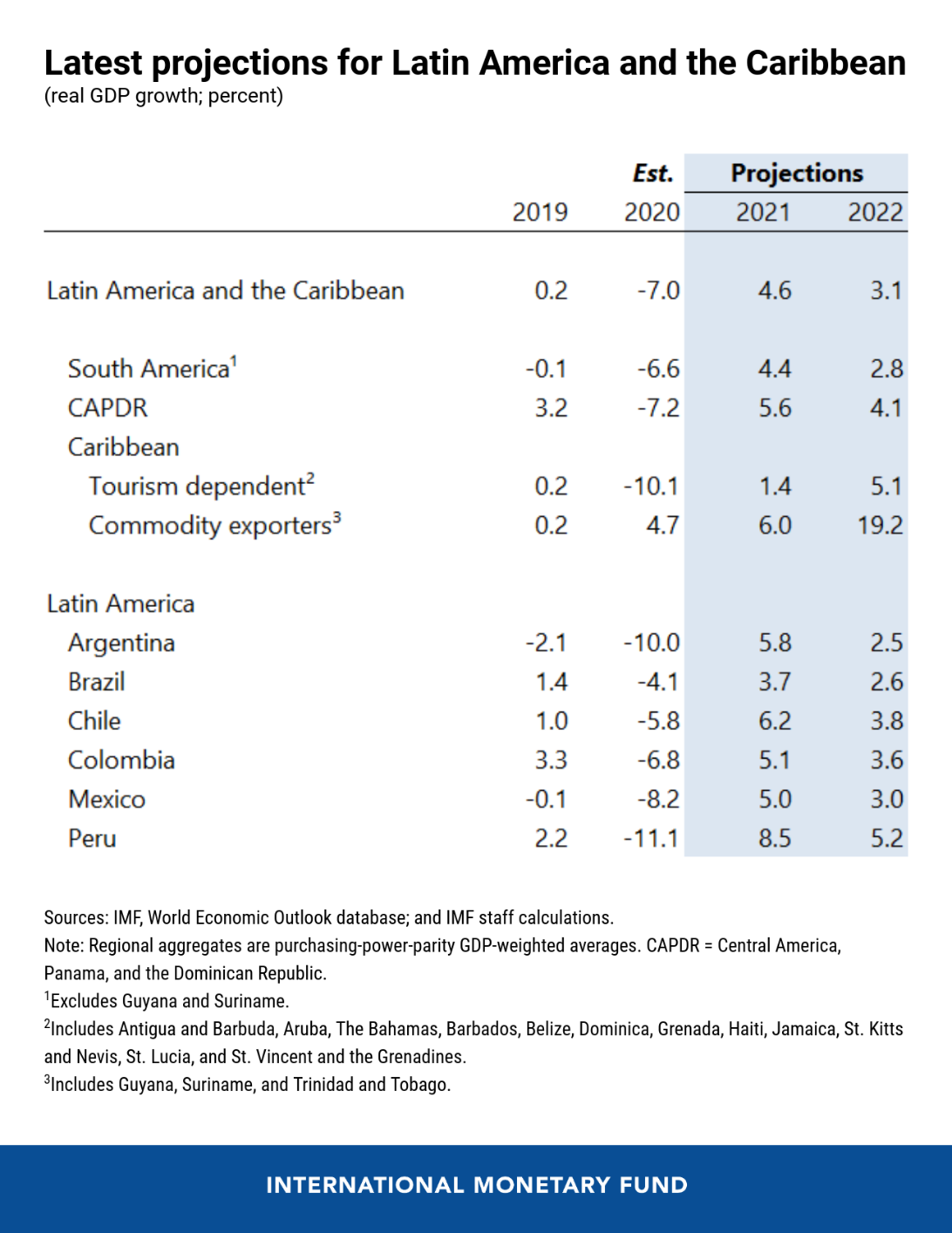
The economy of Latin America and the Caribbean contracted of 7 percent in 2020, the sharpest in the world, far exceeding the global slowdown of 3.3 percent, according to the region's latest economic outlook. Growth for 2021 is projected at 4.6 percent, but the persistence of the health crisis in many countries casts a shadow on the near-term outlook. People and economies continue to require a short-term shot to exit from the COVID-19 crisis, while the aggravation of several underlying structural fragilities poses significant long-term challenges, the IMF's Alejandro WernerTakuji Komatsuzaki, and Carlo Pizzinelli write in new blog on the outlook.

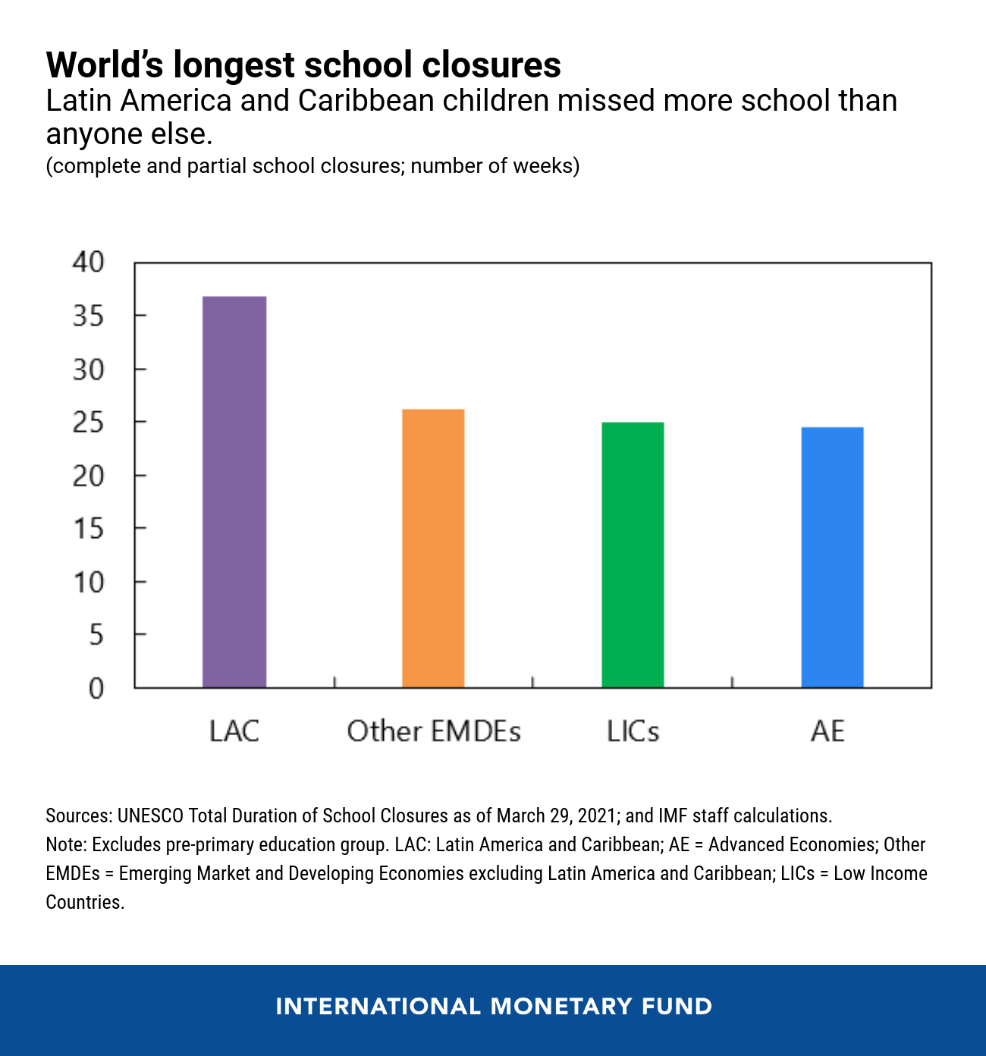
Long-lasting consequences: The pandemic is estimated to have pushed 19 million people into poverty in the region. The unequal impact of the crisis was also seen in school closures, which were longer than in other regions. IMF staff analysis suggests that students aged 10 to 19 might expect a 4 percent lower income on average over their lifetimes if the lost days of schooling in 2020 are not compensated.

Healing longer-term scars will be more challenging and will require accelerating structural reforms, expanding access to high-quality education and health, broadening social safety nets, and improving the business climate. A deeper structural transformation that could be facilitated by a broad fiscal pact is needed to reverse years of slow growth.

Read the blog📺 Watch the press briefing.

SUB-SAHARAN AFRICA NAVIGATING A LONG PANDEMIC

Sub-Saharan Africa will be the world's slowest growing region in 2021 with 3.4 percent growth projected in our latest Regional Economic Outlook. The slow pace of vaccine rollout and limited fiscal space weighs on the outlook. As a result, the gap between sub-Saharan Africa’s growth and the rest of the world is expected to widen further over the next five years. 

On current forecasts, per capita GDP in many countries is not expected to reach pre-crisis levels until the end of 2025. The pandemic is expected to push more than 32 million people into extreme poverty. Read more about the region's challenges through six charts highlighted in a new Country Focus article by the IMF's Abebe Aemro Selassie and Shushanik Hakobyan.

What needs to be done: To climb out of the crisis, the health of public and private balance sheets will need to be restored. International help will be required to meet the $245 billion in additional external funding needs that sub-Saharan Africa’s poorest countries face over the next five years or $425 billion for the region as a whole. The extension of the Group of Twenty debt-service initiative to December 2021 and the new Common Framework on debt can be helpful. The proposed $650 billion special drawing rights allocation would provide about $23 billion to sub-Saharan African countries to help boost liquidity and fight the pandemic. But meeting these needs will require contributions from all potential sources, including the international financial institutions and private sector, and debt-neutral support from donors.

🎧 Listen to a new podcast with the IMF's Papa N'Diaye to hear about how the region is navigating a long pandemic.

Read the Country Focus article or read the full outlook report📺 Watch the press briefing and read Selassie's opening remarks.

VACCINES TO V-SHAPED RECOVERY IN EUROPE

One year into the pandemic, Europe finds itself at another turning point as new waves of infection and new lockdowns hit the continent. The pace of vaccination is slow but an end to the pandemic could be in sight, the IMF's Alfred Kammer writes in a new blog on the outlook for the region.

The recovery in Europe is still halting and uneven. The latest forecast projects that Europe’s economic growth will rebound by 4.5 percent this year. Assuming that vaccines become widely available this year and throughout next, as still expected, growth is projected at 3.9 percent in 2022. This will bring Europe’s output back to its pre-pandemic level but not to the path expected before the pandemic.

The way out: Policymakers will need to look at ways to better target assistance to ensure a more sustainable recovery. That includes shifting job retention policies toward helping workers find new opportunities in emerging sectors, targeting more support toward viable firms and strengthening solvency, and addressing nonperforming loans with adequate provisions.

Read the blogRead the full outlook📺 watch the press briefing or read the transcript.

CHARTING A COURSE FOR ECONOMIC RENEWAL IN EUROPE

IMF Managing Director Kristalina Georgieva discussed Europe's path forward from the pandemic with Paolo Gentiloni, European Commissioner for Economy. Gentiloni highlighted the EU's strong and timely response. He also shared the EU's experience with the vaccine rollout. Although it was slow at first, the vaccination rate has picked up with about 100 million doses administered in the first quarter of the year--a number that is likely to triple in the second quarter, he said.

“We need to not only have a rebound of what we lost, but we need to use this rebound to have a more sustainable, resilient and competitive EU," Gentiloni said.

📺 Watch the full event.

THE ECONOMIC BENEFITS OF TACKLING CLIMATE CHANGE

A Chinese proverbs says, “one generation plants the trees; another gets the shade.” IMF Managing Director Kristalina Georgieva invoked that ancient wisdom during her remarks this week to a People's Bank of China-IMF High Level Seminar of Green Finance and Climate Policy.

"In our research, we analyzed how economic policy tools can pave a road toward net zero emissions by 2050, in a matter that supports economic growth, employment and income equality. For illustration, a policy mix of carbon taxes and green investment stimulus could increase the level of global GDP in the next 15 years by about 0.7 percent and create around 12 million new jobs through 2027," she said.

Stronger international cooperation will need to occur around the areas of climate finance and technology transfers that developing economies need to enhance their own climate efforts. Another immediate priority is to improve the quality of climate disclosure and to harmonize global green finance standardseverywhere—and we need to share best practices across borders. This is essential for the planet, and for financial stability.

Read the full remarks.

DIGITAL MONEY'S ROLE IN REMITTANCES

Digital money has the potential to reshape the way people send money back home to family and friends through remittances. These payments are important to livelihoods and economic activity in developing countries. With risk of a growing digital divide between rich and poor countries, IMF Managing Director Kristalina Georgieva said an effort must be made to ensure all countries can benefit from digital money innovations.

Three areas: In opening remarks at the iLab Spring Meetings Virtual Workshop, the MD said efforts should be focused on three areas. First, new forms of money must remain trustworthy. Second, domestic economic and financial stability must be safeguarded. Finally, frameworks should be geared toward ensuring the international monetary system remains stable and efficient. 

Major players such as the Financial Stability Board, Bank of International Settlements, the World Bank, and industry must leverage its comparative advantages.

"For the IMF that includes using our expertise and experience in surveillance, capacity development, and policy development. And our near-universal membership means we can act as a transmission line of learning and best practice across economies of all sizes," the MD said.

📺 Watch and read her full remarks.

THE URGENCY OF A GREEN RECOVERY

Even as the world works to defeat the pandemic, countries should not lose sight of the threat of climate change, top finance officials said in an event this week. IMF Managing Director Kristalina Georgieva moderated a Fiscal Forum Panel on Climate Change and the Urgency of a Green Recovery with Zainab Shamsuna Ahmed, Minister of Finance, Nigeria; Nigel Clarke, Minister of Finance, Jamaica; Daniele Franco, Minister of Economy and Finance, Italy; and Sri Mulyani Indrawati, Minister of Finance, Indonesia.

The event saw convergence around the need for increasing multilateral momentum; the importance of carbon pricing; and adaptation and transition to a new climate economy through green investments, debt-for-climate change swaps, green bonds for green projects, and green budgeting.

“Addressing climate change will require three things: financing, technology, and knowledge,” said Indrawati. 

📺 Watch the full event here.

BEYOND KEEPING THE RECEIPTS

The IMF’s advice to its members since early in the crisis has been, “spend what you need, but keep the receipts.” A panel this week discussed the lessons learned from recent experience with emergency spending, and how to strengthen governance, transparency, integrity, and service delivery. 

IMF First Deputy Managing Director Geoffrey Okamoto noted that countries undertook a range of accountability and transparency measures such as monitoring spending, providing beneficial ownership information on procurement contracts, and undertaking audits of emergency spending.

“We view the measures introduced into emergency financing in broader context of our long-term commitment to support improved economic governance among our members," he said. 

The panel included Sawsan Gharaibeh, Co-Founder, Rasheed (Transparency International – Jordan); Ghizaal Haress, Ombudsperson, Islamic Republic of Afghanistan; Dondo Mogajane, Director-General, National Treasury, South Africa; and Katherine Siggerud, Chief Operating Officer, U.S. Government Accountability Office.

Lessons learned: Panelists stressed the need to learn from the crisis to strengthen governance and transparency. That includes the importance of ensuring adequate resources to conduct audits, the need to address the equitable distribution of funding, helping countries enhance capacity to improve governance, and working with the media and civil society.

📺 Watch the full event here.

SEVEN THINGS TO KNOW ABOUT SDRs

Ever wanted to explain to your mother how Special Drawing Rights work? Look no further. In our new explainer, we lay out seven things you need to know about a potential new SDR allocation that will make more of the reserve asset available to help countries respond to the COVID-19 pandemic. Find out, in simple terms, what an SDR is, how it will help the global economy, and how countries use them to support their people. If you want to take a deeper dive visit our new SDR website.

F&D: INNOVATION AND INCLUSION IN SIERRA LEONE

In our Spring 2021 issue on the digital future, F&D interviewed David Moinina Sengeh, Sierra Leone’s minister of basic and senior secondary education and chief innovation officer, on finding innovative ways to use technology to manage the health crisis, provide aid to families, and support remote learning for the country’s large public education system. 

Read the interview here, download the PDF, or watch a 3-minute video about his efforts here.

IMF AROUND THE WORLD

The IMF Executive Board recently completed an eighth and final review of Georgia’s economic reform program supported by a four-year extended arrangement under the Extended Fund Facility. The board also recently announced the conclusion of a financial system stability assessment with the Philippines.

IMF staff this week concluded a virtual visit to Kuwait. Over the past two weeks, staff reached an agreement with Afghanistan on the first review of its economic reform program under the Extended Credit Facility. Staff also announced the conclusion of Article IV economic assessments of BotswanaAndorra, and SwitzerlandLast week, IMF staff concluded a technical virtual visit to Mozambique.

IMF Managing Director Kristalina Georgieva spoke with Jordan's Finance Minister, Mohamad Al-Ississ, and Central Bank of Jordan Governor Ziad Fariz. In late March, IMF staff and Jordan reached staff-level-agreement on the second review under the Extended Fund Facility.

Finally, the European Union last week contributed about $199 million worth of SDRs to the IMF's Catastrophe Containment and Relief Trust (CCRT), which provides grants for debt service relief to countries hit by catastrophic events, including public health disasters such as COVID-19.

IMF LENDING

Check out our global policy tracker to help our member countries be more aware of the experiences of others in combating COVID-19. We are also regularly updating our lending tracker, which visualizes the latest emergency financial assistance and debt relief to member countries approved by the IMF’s Executive Board.

To date, 80 countries have been approved for emergency financing, totaling over US$32 billion. Looking for our Q&A about the IMF's response to COVID-19? Click here. We are also continually producing a special series of notes—more than 50 to date—by IMF experts to help members address the economic effects of COVID-19 on a range of topics including fiscal, legal, statistical, tax and more.

HAVE YOUR SAY

Thank you again very much for your interest in the Weekend Read. We really appreciate your time. If you have any questions, comments or feedback of any kind, please do write me a note.

Sincerely,

image

Adam Behsudi
Deputy Editor, IMF Weekend Read
abehsudi@IMF.org

The latest IMF analysis of global economics, finance, development and policy issues shaping the world //


IMF Blog Logo
image


Dear maria,

We just published a new blog—please find the full text below. Translations coming soon.

Also, happening right now: the Europe Regional Economic Outlook press briefing.


From Vaccines to V-Shaped Recovery in Europe

By Alfred Kammer

One year into the pandemic, Europe finds itself at another turning point. New waves of infection are hitting the continent, requiring new lockdowns. But, unlike last year, safe and effective vaccines are now available. While the pace of vaccination is still slow, an end to the pandemic is in sight.

Reflecting the periodic infection waves and the pace of vaccinations, the economic recovery in Europe is still halting and uneven. While industrial production has returned to pre-pandemic levels, the service sector is still contracting.

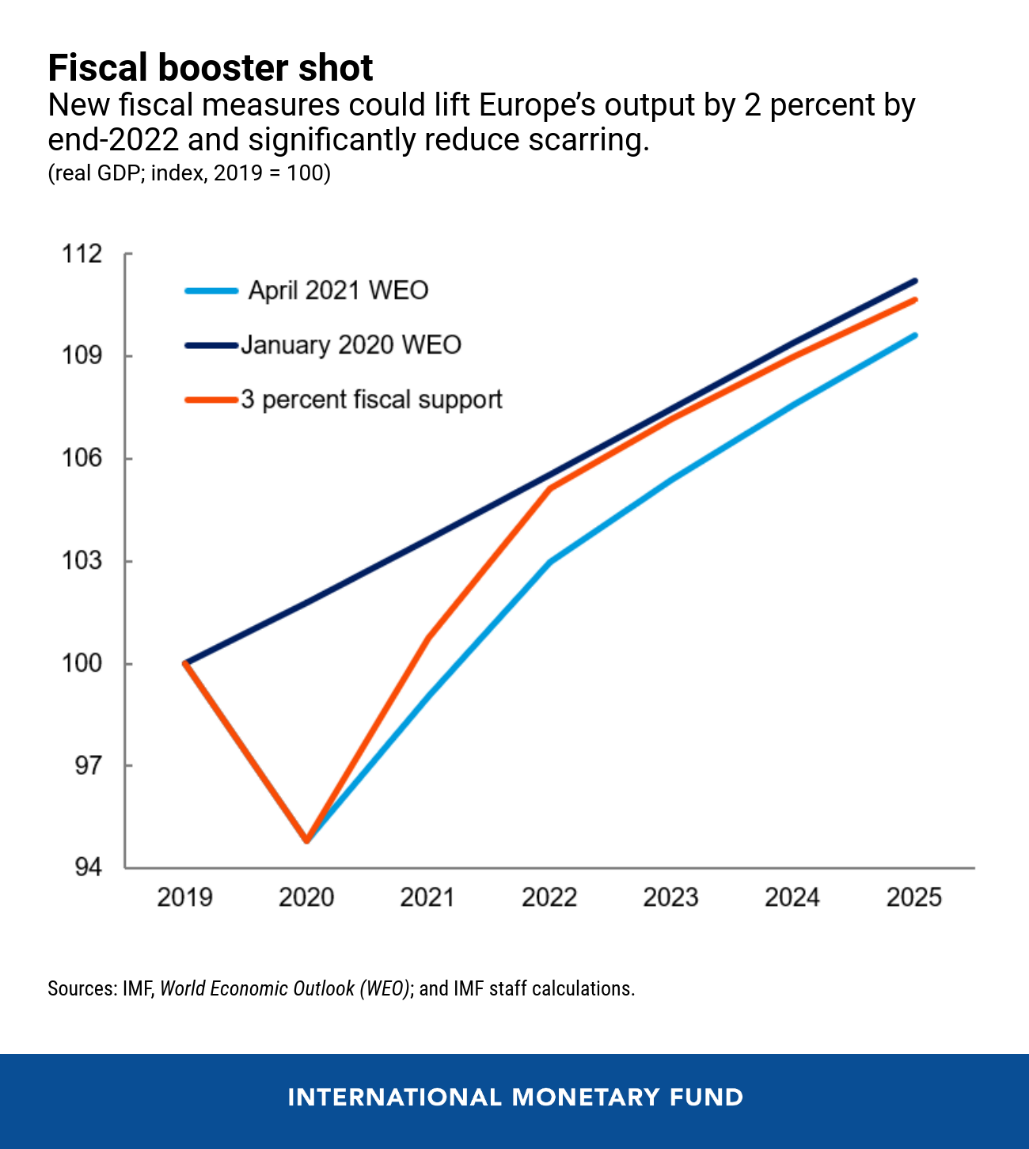
However, looking ahead, we project that Europe’s economic growth will rebound by 4.5 percent this year. Assuming that vaccines become widely available this year and throughout next, as still expected, growth is projected at 3.9 percent in 2022. This will bring Europe’s output back to its pre-pandemic level but not to the path expected before the pandemic.

Virus mutations and vaccination delays are the prime concern at this time. The biggest worry over the medium term is economic scarring—output that never recovers because people who lost jobs during the pandemic cannot find new ones. This can happen because gaps witnessed in education and worker training are never recovered, deferred productive investment remains shelved, or resources remain in declining sectors rather than shifting to expanding ones.

Against this backdrop, the number one priority is to boost vaccine production. This is critical not only for Europe but also the world because Europe is a hub for vaccine production and exports. Investing in such an effort will pay off. Of course, faster vaccine production will need to be coupled with national efforts to quickly distribute these vaccines, getting them out of factories and to people.

chart 1


The way out

At the same time, policymakers need to continue supporting the economic recovery. The faster the recovery, the less scarring experienced by people and businesses. And fiscal policy needs to play an increasing role for economies where monetary policy—with interest rates at their lowest—becomes less effective in boosting output.

But the nature of support will need to shift:

  • Labor market policies have provided unprecedented lifelines to the unemployed or underemployed. At their peak, job retention policies supported 68 million jobs. These should remain in place while economic activity remains soft but should gradually shift toward helping workers find new opportunities in emerging sectors. Some examples include policies that promote job search, enhance training and reskilling programs, and provide well-targeted hiring subsidies.
  • Corporate sector support policies should become more targeted towards viable firms and focus on strengthening firms’ solvency instead of simply providing liquidity. Based on data available through the fall of 2020, we estimate that viable firms will require an increase in equity equivalent to 2-3 percent of GDP to remain solvent, with 15 million jobs at risk.
  • Financial policies should continue to enable banks to keep credit flowing. However, going forward, nonperforming loans need to be adequately provisioned, while banks are given time to replenish capital buffers as crisis measures expire.

A fiscal booster shot

In our latest Regional Economic Outlook Update for Europe, we analyze the impact of additional fiscal measures to support such a shift in policies. These measures could include additional transfers targeted at households in need, hiring subsidies to reintegrate the unemployed faster, temporary investment tax credits to bring forward private investment, and equity support schemes for viable firms in need of capital. This is not a call for a package that boosts spending indiscriminately and permanently, but for a well-targeted and temporary shot in the arm of both demand and supply.

We find that this additional support—set at a level of 3 percent of GDP over 2021−22—could lift GDP by about 2 percent by the end of 2022. Over the medium term, the robust supply side effects of these measures would cut the impact of scarring by more than half. The costs would pale in comparison to the benefits. This package of measures would also offer greater help for low-income households and would entail fewer side effects than additional monetary stimulus. Moreover, it would bring inflation closer to target in many countries and help rebuild monetary policy space.

chart 2


Finally, fiscal support should also be redeployed to accelerate the transformation of the economy, including through infrastructure investment, especially in green and digital technologies. The European Union has broken new ground with the creation of the Next Generation EU plan, which will provide centralized support to member states—over half in the form of grants. This program will accelerate growth and increase productivity, especially if coupled with growth-enhancing structural reforms.

In short, with hard work on vaccine production and distribution, continued support for lives and livelihoods, and innovative policies to combat economic scarring, Europe can have a “V-shaped recovery” that is fairer, greener, smarter, and more resilient.

 Alfred Kammer is the Director of the IMF's European Department.

*****


Thank you again for your interest in IMF Blog. Read more of our latest content here.

Take good care,

Glenn


Glenn Gottselig
Blog Editor, IMF
GGottselig@IMF.org

image


Dear maria,

We just published a new blog—please find the full text below. Translations coming soon.

Also, happening right now: the Western Hemisphere Regional Economic Outlook press briefing.


Short-term shot and long-term healing for Latin America and the Caribbean

By Alejandro Werner, Takuji Komatsuzaki, and Carlo Pizzinelli

Growth in Latin America and the Caribbean recovered briskly in the second half of 2020, yet still more slowly than the global economy and other emerging markets. That’s despite unprecedented policy support, strong performance of trading partners, soaring commodity prices and accommodative global financial conditions. The persistence of the health crisis in many countries casts a shadow on the near-term outlook. People and economies continue to require a short-term shot to exit from the COVID-19 crisis, while the aggravation of several underlying structural fragilities poses significant long-term challenges.

The region’s contraction of 7 percent in 2020 was the sharpest in the world, by far exceeding the global slowdown of 3.3 percent. Growth for 2021 is projected at 4.6 percent, well below the 5.8 percent estimated for emerging markets excluding China. Income per capita will not catch up with its pre-pandemic level until 2024, resulting in a 30 percent cumulative loss relative to the pre-pandemic trend.

Slow and divergent recovery

The outlook, however, is subject to an extraordinary degree of uncertainty as the race between vaccines and the virus continues. On the upside, faster control of the pandemic globally as well as stronger than anticipated domestic policy support would boost growth. Fast vaccination and significant policy support are giving Chile a short-term boost. The country is expected to bounce back already this year to its pre-pandemic GDP level.

On the downside, the recent resurgence of the virus in Brazil, Chile, Paraguay, Peru and Uruguay, combined with slow vaccine rollouts (except in Chile) cast a shadow on the near-term outlook—though new lockdowns are likely to be less damaging than at the start of the pandemic as economies have learned to adjust. Brazil is projected to recover by 2022 due to the withdrawal of fiscal and monetary policy support and slow vaccine rollout. Mexico will only return to its pre-pandemic GDP level by 2023, despite impulse from the US’ large fiscal policy plan, due to the absence of significant domestic fiscal support and the reversal of structural reforms. The American Rescue Plan will boost growth in some Central American countries through trade and remittances, helping these countries to rebound by 2022. Caribbean tourism-dependent economies will be the last to recover (only in 2024) due to the slow resumption in tourism.

The increase in US long-term yields so far has had a somewhat muted impact on asset prices and capital flows in the region. But a continued increase in long-term interest rates remains a risk.

Unequal effects

The recovery has also been heterogeneous within countries. Manufacturing has rebounded faster than contact-intensive services, aided by exports in some cases, particularly in Mexico. However, labor markets remain fragile—only two-thirds of those who lost jobs at the beginning of the pandemic in Brazil, Chile, Colombia, Mexico and Peru were employed again by the end of last year. The informal sector, which suffered the largest losses initially, has driven the job recovery.

Average labor income fell since the beginning of the pandemic, with pronounced divergences in labor market outcomes across countries, sectors, and demographic groups. Countries that implemented employment retention schemes (for example, Brazil) had a less dramatic fall in employment but the recovery has also been slower. However, even in the case of a relatively quick recovery in Mexico, those who have been reemployed have had larger earning losses than those whose employment remained uninterrupted during the crisis. Women and low-educated workers have struggled the most. Low-skilled female workers in particular lost more jobs or had to cut back on working hours even when able to retain employment, suffering the largest income losses.

chart 1


Long-lasting consequences

Poverty is estimated to have increased by 19 million people, and inequality, as measured by the Gini coefficient, increased by 5 percent compared to pre-crisis levels. The pandemic will also leave long-lasting damage to human capital from school closures, which were longer than in other regions.

chart 2


While the precise learning losses are difficult to estimate, staff analysis suggests that students aged 10 to 19 might expect a 4 percent lower income on average over their lifetimes if the lost days of schooling in 2020 are not compensated.


The income losses differ among countries, depending on how much the pandemic reduces the chance of completing secondary education and on the size of the skill premium for higher education. The losses will be greatest for students whose families are less able to support out-of-school learning, exacerbating already high income inequality and low levels of educational attainment.

chart 3


The most urgent task continues to be controlling the pandemic, by ensuring that health care systems are adequately resourced, and everybody can be vaccinated. Fiscal and monetary policies should remain supportive in countries where there is sufficient policy space—a short-term shot for their economies—while countries with tight budgets should reprioritize spending towards healthcare and support for households, and work to create additional fiscal space. Given the continued heavy toll on low-income workers, targeted support to facilitate job creation and retraining may be warranted.

Healing longer-term scars will be more challenging and will require accelerating structural reforms, expanding access to high-quality education and health, broadening social safety nets, and improving the business climate. A deeper structural transformation that could be facilitated by a broad fiscal pact is needed to reverse years of slow growth.

chart 4


Alejandro Werner is Director of the IMF's Western Hemisphere Department.

Takuji Komatsuzaki is a senior economist in the Regional Studies Division of the IMF’s Western Hemisphere Department.

Carlo Pizzinelli is an economist in the Regional Studies Division of the IMF's Western Hemisphere Department.


Thank you again for your interest in IMF Blog. Read more of our latest content here.

Take good care,

Glenn


Glenn Gottselig
Blog Editor, IMF
GGottselig@IMF.org

The latest IMF analysis of global economics, finance, development and policy issues shaping the world //


Dear maria,

We just published a new blog—please find the full text below. Translations coming soon.


A COVID-19 Recovery Contribution

By Vitor Gaspar, Michael Keen, Alexander Klemm, and Paolo Mauro

The economic costs of the pandemic have fallen most heavily on those least able to bear them. Governments have taken steps to support people and firms through wage subsidies, unemployment benefits, and other fiscal measures. But more investment in health care, education, and other basic public services will still be needed, and this will come at a cost. With rising inequality and mounting public debt, countries will have to find innovative approaches to raise the money to pay for it all.

To this end, governments are now starting to focus on mobilizing revenue from corporations and individuals who can best afford to pay. This revenue will help meet the extraordinary financing needs arising from the pandemic, while also promoting social cohesion in these difficult times. As with many things, attitudes toward taxation and the degree to which its burden should fall on the better-off are being reshaped by the pandemic.

Growing support for progressive taxation

One revenue-raising option that may be timely and attract political support is progressive taxation. Evidence from a recent survey of 2,500 US residents suggests that the pandemic and its adverse economic consequences may lead to more favorable opinions of progressive taxation. (A tax is progressive if the tax liability, as a share of a person’s income, rises with income.) This result is consistent with previous findings that attitudes toward public policies can be molded by personal experience during crises and other upheavals with a major economic impact.

The survey solicited people’s views in favor of, or against:

  • Increasing taxation as a way of financing the economic recovery as well as additional expenditures made necessary by the pandemic;
  • Introducing a temporary tax explicitly linked to this goal; and
  • Permanently increasing the degree of progressivity of taxation (with variations such as increasing taxation on people with incomes above average, only the rich, multinational corporations, etc.)

The key result is that respondents who have experienced serious illness or job loss as a result of COVID-19—or personally know someone who has—favor progressive taxation to a greater extent than others in the sample, by a wide margin (19 percentage points). Our results also hold in more advanced analysis, such as regressions controlling for demographic factors, socioeconomic variables, and preferences for various categories of spending (such as education, health, environment, police, military, and border protection).

chart


Results based on surveys must be interpreted with caution. The findings show that people who have been directly hurt by the pandemic tend to be stronger advocates for state support of those in need and that this effect is more pronounced for those who previously held unfavorable views on progressive taxation. It is, however, uncertain how strongly held such views will be—or how long they will last. Moreover, other factors may simultaneously be causing a shift in attitudes. For example, past epidemics have been followed by weaker trust in government. But overall, these results suggest that public sentiment may be shifting in favor of more progressive taxation.

Fostering an inclusive recovery

Given the public mood during this unique period in history, policymakers could consider introducing COVID-19 recovery contributions to raise the resources needed for an inclusive recovery. These contributions (not to be confused with a “wealth tax,” which targets households’ net assets, such as investments like stock and bond holdings), levied on the better-off, could take the form of surcharges on personal income taxes or on “excess profits” (read more information on legal issues in implementation here.) The basic idea would be that those who can afford to pay more – individuals with high incomes or businesses with extraordinary profits – should make a greater contribution from their earnings. This strategy recognizes the importance of social cohesion in coping with the crisis, given that much of the burden has fallen on the less affluent. While many restaurant workers, small business owners, and myriad others have lost their livelihoods, other businesses—such as some in the pharmaceutical sector and many that are highly digitalized—have enjoyed strong profits.

There is historical precedent for temporary surcharges on personal income taxes during exceptional circumstances. Germany implemented one in 1991 in the wake of reunification, as did Australia in 2011 following damaging floods in Queensland and Japan in 2013 after the Tohoku earthquake. Such a tax is typically implemented as a simple surcharge on the personal income tax and thus strengthens the progressivity of the underlying tax, while being easy to put in place. In countries where the existing tax is not very progressive, it would be important to design the surtax in a progressive manner.

Excess profit taxes—contributions from businesses that prosper during or after a crisis—were used in the United States, the United Kingdom, and other countries during and after the two world wars, raising considerable amounts of money. To prevent any negative impact on investment and growth, these taxes were levied only on estimated economic rents—that is, the part of profits that exceed a normal return required to make an activity worthwhile.

To complement these domestic efforts, we believe that an agreement to reform international corporate taxation—making it better able to reach economic rents of highly profitable multinationals and limiting mutually damaging tax competition—should be a priority in a global economy increasingly shaped by digitalization and automation. Such agreement would also help to increase revenues in a progressive manner.

The need for solidarity

The pandemic is a test of social solidarity, cohesion, and government effectiveness. Individuals who have been harmed by the pandemic are likely to demand more redistributive policies. If their demands are unmet, these citizens may grow disillusioned and lose trust in the government. Likewise, when the crisis has eased, if governments are perceived as having supported rich individuals and corporations more generously than those sacrificing and hurting the most, there will be a risk of political backlash or social unrest. The stakes are thus high. Policymakers need to deliver not just on the health front but also on policies that foster more equal distribution of incomes and access to government services.

More generally, as we confront the difficult task of fostering the economic recovery while safeguarding the health of the public finances, policymakers would be well advised to ensure that those most hurt do not feel left behind.

Vitor Gaspar is Director of the IMF’s Fiscal Affairs Department.

Michael Keen is Deputy Director of the IMF’s Fiscal Affairs Department. 

Alexander Klemm is a Senior Economist in the Western Hemisphere Department.

Paolo Mauro is Deputy Director in the IMF’s Fiscal Affairs Department. 


Thank you again for your interest in IMF Blog. Read more of our latest content here.

Take good care,

Glenn


Glenn Gottselig
Blog Editor, IMF
GGottselig@IMF.org

Ετικέτες

"ΠΑΡΑΠΟΝΟ ΦΥΛΗΣ" ΠΟΛΥΕΤΗΣ ΗΛΕΚΤΡΟΝΙΚΟΣ ΙΣΤΟΧΩΡΟΣ ΕΙΔΗΣΕΩΝ

"ΠΑΡΑΠΟΝΟ ΦΥΛΗΣ" ΠΟΛΥΕΤΗΣ ΗΛΕΚΤΡΟΝΙΚΟΣ ΙΣΤΟΧΩΡΟΣ ΕΙΔΗΣΕΩΝ

"ΔΙΚΑΙΟΣΥΝΗ για τον μικρό μας Αγγελο,ΜΑΡΙΟ ΣΟΥΛΟΥΚΟ"

"ΔΙΚΑΙΟΣΥΝΗ για τον μικρό μας Αγγελο,ΜΑΡΙΟ ΣΟΥΛΟΥΚΟ"
Η ΕΦΗΜΕΡΙΔΑ "ΠΟΛΙΤΙΚΗ" θα ζητά ΕΣΑΕΙ.."ΔΙΚΑΙΟΣΥΝΗ ΓΙΑ ΤΟΝ ΜΑΡΙΟ ΣΟΥΛΟΥΚΟ"!!

ΕΘΝΙΚΟ ΚΕΝΤΡΟ ΠΑΡΑΣΚΕΥΗΣ ΠΑΡΑΓΩΓΩΝ ΑΙΜΑΤΟΣ "ΗΛΙΑΣ ΠΟΛΙΤΗΣ"

ΕΘΝΙΚΟ ΚΕΝΤΡΟ ΠΑΡΑΣΚΕΥΗΣ ΠΑΡΑΓΩΓΩΝ ΑΙΜΑΤΟΣ "ΗΛΙΑΣ ΠΟΛΙΤΗΣ"
Ερευνα,Συνεντεύξεις και επισήμανση της σπουδαιότητος του τότε ΕΘΝΙΚΟΥ ΚΕΝΤΡΟΥ ΠΑΡΑΣΚΕΥΗΣ ΠΑΡΑΓΩΓΩΝ ΑΙΜΑΤΟΣ "ΗΛΙΑΣ ΠΟΛΙΤΗΣ" απο το Περιοδικό "ΑΧΑΡΝΕΩΝ Εργα" το έτος 2004!!
Ο Ιστοχώρος μας ΔΕΝ ΛΟΓΟΚΡΙΝΕΙ τα κείμενα των Αρθρογράφων του. Αυτά δημοσιεύονται εκφράζοντας τους ιδίους.
Απαγορεύεται η αναδημοσίευση, αναπαραγωγή, ολική, μερική ή περιληπτική ή κατά παράφραση ή διασκευή ή απόδοση του περιεχομένου του παρόντος διαδικτυακού τόπου σε ό,τι αφορά τα άρθρα της ΜΑΡΙΑΣ ΧΑΤΖΗΔΑΚΗ ΒΑΒΟΥΡΑΝΑΚΗ και του ΓΙΑΝΝΗ Γ. ΒΑΒΟΥΡΑΝΑΚΗ με οποιονδήποτε τρόπο, ηλεκτρονικό, μηχανικό, φωτοτυπικό ή άλλο, χωρίς την προηγούμενη γραπτή άδεια των Αρθρογράφων. Νόμος 2121/1993 - Νόμος 3057/2002, ο οποίος ενσωμάτωσε την οδηγία 2001/29 του Ευρωπαϊκού Κοινοβουλίου και κανόνες Διεθνούς Δικαίου που ισχύουν στην Ελλάδα.

Tι ήταν η ΕΦΗΜΕΡΙΔΑ «ΠΟΛΙΤΙΚΗ»..για όσους δεν γνωρίζουν.

Η «ΠΟΛΙΤΙΚΗ» γεννήθηκε το 2000,ως συνέχεια του Περιοδικού «ΑΧΑΡΝΕΩΝ Έργα». Δημιουργήθηκε από Επαγγελματίες Εκδότες με δεκαετίες στον τομέα της Διαφήμισης, των Εκδόσεων και των Δημοσίων Σχέσεων και αρχικά ήταν μια Υπερτοπική Εφημερίδα με κύριο αντικείμενο το Αυτοδιοικητικό Ρεπορτάζ.

Επί χρόνια, κυκλοφορούσε την έντυπη έκδοσή της σε ένα ικανότατο τιράζ (5000 καλαίσθητων φύλλων εβδομαδιαίως) και εντυπωσίαζε με την ποιότητα της εμφάνισης και το ουσιώδες, μαχητικό και έντιμο περιεχόμενο της.
Η δύναμη της Πένας της Εφημερίδας, η Ειλικρίνεια, οι Ερευνές της που έφερναν πάντα ουσιαστικό αποτέλεσμα ενημέρωσης, την έφεραν πολύ γρήγορα πρώτη στην προτίμηση των αναγνωστών και γρήγορα εξελίχθηκε σε Εφημερίδα Γνώμης και όχι μόνον για την Περιφέρεια στην οποία κυκλοφορούσε.

=Επι είκοσι τέσσαρα (24) χρόνια, στηρίζει τον Απόδημο Ελληνισμό, χωρίς καμία-ούτε την παραμικρή- διακοπή

. =Επί είκοσι τέσσαρα ολόκληρα χρόνια, προβάλλει με αίσθηση καθήκοντος κάθε ξεχωριστό, έντιμο και υπεύθυνο Πολιτικό της Πολιτικής Σκηνής. Στις σελίδες της, θα βρείτε ακόμα και σήμερα μόνο άξιες και χρήσιμες Πολιτικές Προσωπικότητες αλλά και ενημέρωση από κάθε Κόμμα της Ελληνικής Βουλής. Η «ΠΟΛΙΤΙΚΗ» ουδέποτε διαχώρησε τους αναγνώστες της ανάλογα με τα πολιτικά τους πιστεύω. Επραττε το καθήκον της, ενημερώνοντας όλους τους Ελληνες, ως όφειλε.

=Επί είκοσι τέσσαρα ολόκληρα χρόνια, δίνει βήμα στους αδέσμευτους, τους επιτυχημένους, τους γνώστες και θιασώτες της Αλήθειας. Στηρίζει τον Θεσμό της Ελληνικής Οικογένειας, την Παιδεία, την Ελληνική Ιστορία, προβάλλει με όλες της τις δυνάμεις τους Αδελφούς μας απανταχού της Γης, ενημερώνει για τα επιτεύγματα της Επιστήμης, της Επιχειρηματικότητας και πολλά άλλα που πολύ καλά γνωρίζουν οι Αναγνώστες της.

=Επί είκοσι τέσσαρα ολόκληρα χρόνια, ο απλός δημότης–πολίτης, φιλοξενείται στις σελίδες της με μόνη προϋπόθεση την ειλικρινή και αντικειμενική γραφή και την ελεύθερη Γνώμη, η οποία ΟΥΔΕΠΟΤΕ λογοκρίθηκε.

Η ΕΦΗΜΕΡΙΔΑ «ΠΟΛΙΤΙΚΗ», είναι ένα βήμα Ισονομίας και Ισοπολιτείας, έννοιες απόλυτα επιθυμητές, ιδιαιτέρως στις ημέρες μας. Είναι ο δικτυακός τόπος της έκφρασης του πολίτη και της εποικοδομητικής κριτικής, μακριά από κάθε στήριξη αφού δεν ετύγχανε οικονομικής υποστήριξης από Δήμους, Κυβερνήσεις ή όποιους άλλους Δημόσιους ή Ιδιωτικούς Φορείς, δεν είχε ΠΟΤΕ χορηγούς, ή οποιασδήποτε μορφής υποστηρικτές. Απολαμβάνει όμως Διεθνούς σεβασμού αφού φιλοξενεί ενημέρωση από αρκετά ξένα Κράτη πράγμα που της περιποιεί βεβαίως, μέγιστη τιμή.

Η ΕΦΗΜΕΡΙΔΑ «ΠΟΛΙΤΙΚΗ» διαγράφει απο την γέννησή της μια αξιοζήλευτη πορεία και απέκτησε εξ αιτίας αυτού,ΜΕΓΙΣΤΗ αναγνωσιμότητα. Η Εφημερίδα «ΠΟΛΙΤΙΚΗ» κέρδισε την αποδοχή και τον σεβασμό που της ανήκει, με «εξετάσεις» εικοσι τεσσάρων ολόκληρων ετών, με συνεχείς αιματηρούς αγώνες κατά της τοπικής διαπλοκής, με αγώνα επιβίωσης σε πολύ δύσκολους καιρούς, με Εντιμότητα, αίσθηση Καθήκοντος και Ευθύνης.

ΕΙΚΟΣΙ ΠΕΝΤΕ ΟΛΟΚΛΗΡΑ ΧΡΟΝΙΑ "ΠΟΛΙΤΙΚΗ"!! 2000-2025

ΕΙΚΟΣΙ ΠΕΝΤΕ ΟΛΟΚΛΗΡΑ ΧΡΟΝΙΑ "ΠΟΛΙΤΙΚΗ"!! 2000-2025

Οι αρθρογράφοι των οποίων τα άρθρα δημοσιεύονται ώδε ΔΕΝ ΛΟΓΟΚΡΙΝΟΝΤΑΙ επ ουδενί.

Οι αρθρογράφοι των οποίων τα άρθρα δημοσιεύονται ώδε ΔΕΝ ΛΟΓΟΚΡΙΝΟΝΤΑΙ επ ουδενί. Οι απόψεις τους αφορούν τους ιδίους και όχι απαραίτητα την θέση και άποψη της Εφημερίδας.