Σελίδες

Δευτέρα 4 Μαρτίου 2019

USA's interesting news

Bureau of Consumer Protection. Business Alerts From the Federal Trade Commission

By Andrew Smith, Director, FTC Bureau of Consumer Protection
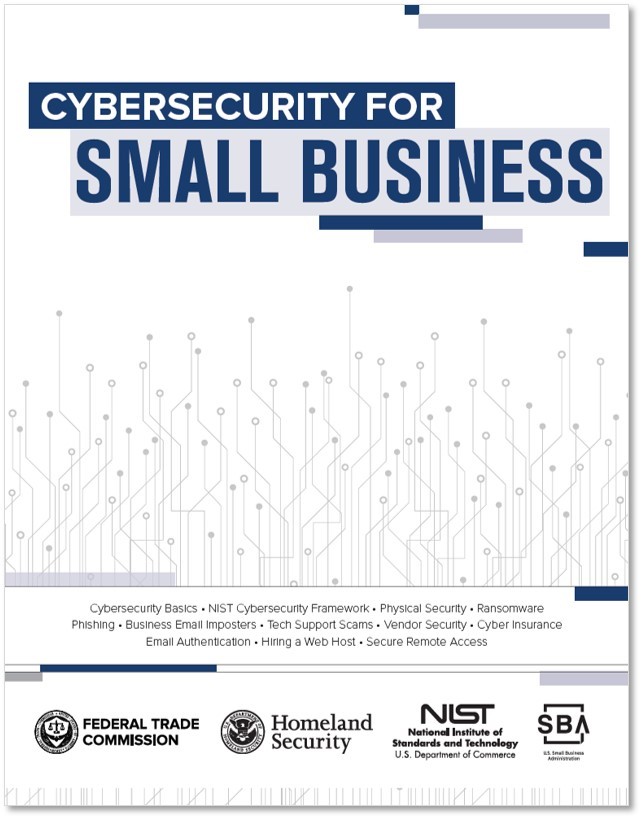
When it came to designing the FTC’s Cybersecurity for Small Business campaign, you called the shots. We hosted round tables across the country and listened to what business owners had to say. You told us you wanted: 1) No-nonsense advice that’s easy to implement; and 2) Consistent guidance from the different federal agencies that deal with cyber threats and data security.
Our every-Friday Business Blog series has covered fundamentals like physical security and cybersecurity basics, as well as tech-centric topics like email authentication and NIST’s Cybersecurity Framework. But it’s time for us to turn things back to you. We asked small businesses how they have incorporated the campaign in their offices and here are four ways you’ve told us you’re using the new materials.
Cybersecurity for Small Business brochure

Read more >

FTC@100 Banner

The Commission also approves applications for sale of assets to Matheson Tri-Gas, Inc., and to Messer Group GmbH and CVC Capital Partners
Following a public comment period, the Federal Trade Commission has approved a modified final order requiring industrial gas suppliers Praxair, Inc. and Linde AG to sellassets in nine industrial gases product markets in numerous U.S. geographic markets to four divestiture buyers. The nine product markets in which the Commission alleged harm in its October 2018 complaint are bulk liquid oxygen, bulk liquid nitrogen, bulk liquid argon, bulk liquid carbon dioxide, bulk liquid hydrogen, bulk refined helium, on-site hydrogen, on-site carbon monoxide, and excimer laser gases.
According to the complaint, the merger, as originally proposed, would have eliminated direct competition between Praxair and Linde in each of the nine product markets, and would have enabled the merged firm to exercise market power unilaterally by raising prices in those markets. Without the required divestitures, the proposed merger also would have made collusion or coordinated action among the remaining firms in the nine product markets more likely.
The Commission made two material modifications to the proposed order issued in October 2018. The first modification specifies the scope of the intellectual property that the newly merged Linde must divest. The second modification concerns the joint venture between Messer Group GmbH (“Messer”) and CVC Capital Partners (“CVC”) that is acquiring some of the divested assets. The modified final order gives the Commission the right of prior approval if Messer’s stake in the joint venture falls below 50 percent or if Messer and CVC decide to sell their combined interest in the joint venture to a third party.
The Commission has also approved an application from the parties to divest five on-site hydrogen and carbon monoxide production facilities outside the Gulf Coast region, a hydrogen pipeline in the Gulf Coast region, intellectual property, customer contracts, and other related assets to Matheson Tri-Gas, Inc. In addition, the Commission has approved an application from the parties to divest facilities that produce liquid atmospheric gases, liquid carbon dioxide, liquid hydrogen, laser gases, and liquid helium to the Messer/CVC joint venture.  Thus, the Commission has approved applications for all the divestitures required by the Commission’s final order in this case.
Prior to the merger, Praxair was the world’s third-largest industrial gas supplier by revenue, and Linde was the second-largest global industrial gas supplier. The merger creates the largest industrial gas company in the world.
The Commission vote to approve the modified final order in this matter was 4-1. Commissioner Rohit Chopra dissented. The Commission votes to approve the parties’ applications to divest assets to Matheson Tri-Gas, Inc., and the Messer/CVC joint venture were both 4-0-1, with Commissioner Rohit Chopra abstaining.
The Federal Trade Commission works to promote competition, and protect and educate consumers. You can learn more about how competition benefits consumers or file an antitrust complaint. Like the FTC on Facebook, follow us on Twitter, read our blogs, and subscribe to press releases for the latest FTC news and resources.
More news from the FTC >>


The Federal Trade Commission has reached a settlement in FTC v. Actavisthe 2009 FTC case alleging that the brand-name drug company Solvay and three generic drug companies illegally agreed to restrict generic competition to Solvay’s branded testosterone-replacement drug AndroGel for nine years.
After the district court dismissed the FTC’s complaint and the appellate court affirmed the district court decision, the Supreme Court, in June 2013, rejected lower court rulingsthat treated “reverse-payment” patent settlements (agreements in which the patent holder pays the alleged infringer) as largely immune from antitrust law. The Court held such agreements are subject to antitrust scrutiny. The case was remanded to the district court, and trial was scheduled to begin on March 4, 2019.
FTC v. Actavis turned the tide on anticompetitive reverse payments in the pharmaceutical industry,” said Chairman Joe Simons. “After the Supreme Court recognized the harmful effects that reverse-payment agreements can have on competition and ultimately on consumers, we have seen fewer of these types of agreements.”
The settlement covers those products that Solvay may have been marketing or developing before its purchase in 2010 by Abbott Laboratories, which later spun off its worldwide pharmaceutical business into AbbVie Inc.
Under the settlement, Solvay’s current owner AbbVie is prohibited from entering into certain patent infringement settlement agreements that restrict generic entry for certain drugs and contain common forms of reverse payments, such as: (1) a side deal, in which the generic company receives compensation in the form of a business transaction entered at the same time as the patent litigation settlement; or (2) a no-AG commitment, in which a brand company agrees not to compete with an authorized generic version of a drug for a period of time.
The settlement exempts licenses to enter the market on a later date, compensation for saved future litigation costs up to $7 million, a continuation or renewal of a pre-existing agreement, and several other types of agreements that are unlikely to be anticompetitive.
The order, if approved by the court, will remain in effect for 10 years.
The Commission vote approving Stipulated Order for Permanent Injunction was 4-0-1. Commissioner Christine S. Wilson was recused. The FTC filed the proposed order in the U.S. District Court for the Northern District of Georgia.
NOTE: Stipulated final orders have the force of law when signed and entered by a District Court judge.
The Federal Trade Commission works to promote competition, and protect and educate consumers. You can learn more about how competition benefits consumers or file an antitrust complaint. Like the FTC on Facebook, follow us on Twitter, read our blogs, and subscribe to press releases for the latest FTC news and resources.


More news from the FTC >>
USAGov Logo


Icon_Health (1)
Healthy Sleep Habits
Are your children getting sufficient sleep? Sleep is critical to prevent both physical and mental health issues like obesity and attention problems. Use this handy infographic from the Centers for Disease Control to find tips for good sleep and how many hours your child needs.
Icon_Education
Adoption Information
Are you interested in starting or expanding your family through adoption? For information about this life-changing process, check out this resource from the Child Welfare Information Gateway. Find details about the history of adoption in the U.S., different options to start the process, and much more.
Icon_History01 (1)
The Importance of Reading
Reading can unlock new worlds and points of view for children of any age. Visit Read.gov/kids to find an archive of books on topics from history to sports to U.S. presidents. You can also use the suggested booklists and community resources to build a reading plan and expand your kids' horizons.

Icon_Devices02
Smithsonian Webinar on Archaeology
Take a virtual, behind-the-scenes visit to the Smithsonian with archivist and collections technician Molly Kamph! See unique artifacts from the famous Neanderthal site of Shanidar Cave and learn how field discoveries and archival materials reveal untold stories about these early humans. Register for and learn more about this free webinar going live on Thursday, March 14!
Icon_Science (2)
Recycling Projects
Do you have students interested in recycling around the time of school or state science fairs? Sometimes it's difficult to come up with an experiment idea, but the Environmental Protection Agency (EPA) can help! Use this PDF handout to break down the project brainstorming process and think of ideas for recycling projects.
Icon_Education (1)
Science Fair Project How-Tos
The National Aeronautics and Space Administration (NASA) has a step-by-step guide with videos on ‘How to Do a Science Fair Project.’ These will help your students get started, execute their experiments, and set up a great presentation board. Help make this year's science fair the best yet!