To all of our first responders: ‘Thank you!’
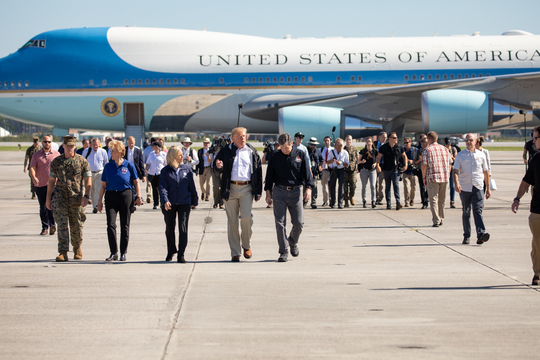
As President Donald J. Trump visits the Carolinas today, nearly 20,000 Federal employees have been mobilized to help restore power, rescue stranded victims, and assist in all aspects of the recovery following Hurricane Florence.
The numbers behind the Federal response:
- More than 2,000 rescues and nearly 15,000 individuals sheltered by FEMA
- Some 6,000 active-duty personnel and 7,000 National Guardsmen on scene
- At least 400 lives—and 200 pets—saved by the U.S. Coast Guard
- More than 100 priority sites beginning to be assessed by the EPA
- 40,000 individuals working with the Department of Energy to restore power
- 535 rescue-and-evacuation missions and counting performed or supported by the National Guard in North Carolina
The President delivered a, clear message during his visit to affected communities today: “The Federal Government is behind you.” He thanked state leaders, first responders, and local officials for working around the clock to help all victims get the assistance they need. “Whatever we need from Washington, we are there.”
The widespread devastation of this storm demands a Government-wide response, and that is what the Trump Administration has worked to deliver. The Department of Veterans Affairs is moving to open facilities that were closed by the storm, and the Small Business Administration has announced assistance for homeowners, renters, and businesses of all sizes in addition to opening a business recovery center.
Number of new heroin users cut in half
The scale of America’s opioid crisis can be daunting, with more than 72,000 drug overdose deaths in 2017—most of them involving opioids. But everywhere the crisis has struck, there are signs of hope and resilience. Every life saved from addiction is an important victory. And just last week, the country got encouraging news.
The Department of Health and Human Services (HHS) has released its annual survey of American drug use and mental health. “For the second year in a row, the number of Americans misusing legal or illegal opioids dropped,” HHS Secretary Alex Azar writes in an op-ed today.
“Even more encouraging, the number of Americans initiating heroin use dropped by around half from 2016 to 2017.” HHS’ survey provides hard and welcome evidence that aggressive efforts from the Federal Government, local communities, faith-based organizations, and others are working for the people who need it most.
Photo of the Day
Official White House Photo by Shealah Craighead
President Donald J. Trump, along with members of his Administration, visit North Carolina to help in the recovery following Hurricane Florence | September 19, 2018
The White House • September 18, 2018
|
A ‘new direction’ against biological threats
Today marks the 17th anniversary of the infamous “anthrax letters,” distributed beginning one week after the September 11 attacks of 2001. “Thought to be an indication of possible further terrorist activity,” National Security Advisor John Bolton says, these letters brought to Americans’ attention—many for the first time—the very real threat of bioweapons in the hands of our enemies.
America cannot afford to take chances. Under President Donald J. Trump, it won’t. Today, the President signed off on a first-of-its-kind National Biodefense Strategy, one that signals “a new direction” in our approach to biological threats.
The strategy’s key objective is creating a more efficient and accountable biodefense enterprise. Until now, Federal agencies have had disparate programs that were not centrally coordinated. Today’s Memorandum names Secretary of Health and Human Services Alex Azar as the Federal lead for biodefense and establishes a Cabinet-level Biodefense Steering Committee.
Biological threats know no borders. Whether naturally occurring, accidental, or deliberate in nature, these risks are among the most serious facing America and its allies. The 2001 anthrax attacks, the 2009 influenza pandemic, the 2014 Ebola epidemic, and the more recent Zika epidemic all reveal the potential for widespread harm and anxiety if such threats are left ignored.
“With these actions today, I am reaffirming my unwavering commitment to protecting the American people, the American homeland, and the American way of life,” President Trump writes.
‘Critical bipartisan legislation’ on opioids
Yesterday, Congress scored a bipartisan win in its effort to take on America’s opioid crisis. The Senate passed its Amendment to H.R. 6, the Opioid Crisis Response Act of 2018, which takes a major step toward realizing a whole-of-government approach to combatting drug demand.
President Trump has made the opioid response a top priority across his Administration. Toward that end, this vital legislation would:
- Reduce the amount of illicit fentanyl entering the country
- Improve treatment for infants suffering from neonatal abstinence syndrome
- Create job-training programs for Americans in recovery
- Reauthorize the Office of National Drug Control Policy to continue overseeing Federal drug control efforts, including public awareness campaigns
“The Administration looks forward to working with both chambers as the legislative process continues to get a bill to the President’s desk to mitigate this crisis next door,” White House Press Secretary Sarah Sanders said in a statement.
Photo of the Day
Official White House Photo by Benjamin Tuck
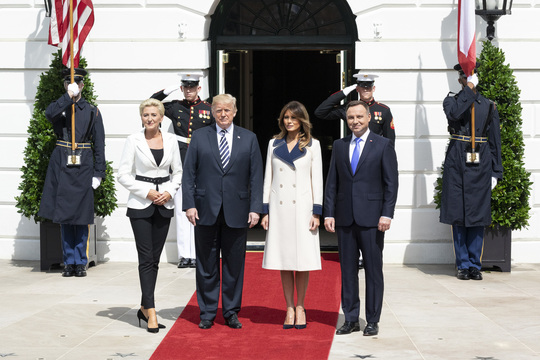
President Donald J. Trump and First Lady Melania Trump welcome His Excellency Andrzej Duda, President of the Republic of Poland, and Mrs. Kornhauser-Duda to the White House | September 18, 2018
|
 |
Alfredo Ortiz: Hispanics Flourishing in Trump Economy
|
“President Trump's economy is the rising tide that is lifting all boats. This is especially true for Hispanics, who were among the biggest victims of the low-growth, high-regulation economy under President Obama,” Job Creators Network CEO Alfredo Ortiz writes in The Hill.
“Last week, the Census Bureau announced new household income numbers, which showed that median income for Hispanic households grew by 3.7 percent, adjusted for inflation, last year. That’s more than double the increase seen by all households . . . That’s welcome news as the nation celebrates Hispanic Heritage Month.”
“U.S. President Donald Trump welcomed developments on Wednesday at an inter-Korean summit in the North Korean capital of Pyongyang as ‘very exciting,’” Reutersreports. “Kim Jong Un has agreed to allow nuclear inspections, subject to final negotiations, and to permanently dismantle a test site and launch pad in the presence of international experts,” the President wrote on Twitter.
“Biological threats emanate from many sources, and they know no borders,” President Trump said in a statement yesterday as his Administration released its National Biodefense Strategy. “They have great potential to disrupt the economy, exact a toll on human life, and tear at the very fabric of society.” The President has tasked Health and Human Services Secretary Alex Azar with leading the Federal review, Tom Howell, Jr. reports for The Washington Times.
“A top economic adviser to President Ronald Reagan said Tuesday that President Barack Obama deserves no credit for the booming U.S. economy, and said all of the credit belongs to President Trump,” Pete Kasperowicz writes in the Washington Examiner. On Fox News, renowned economist Art Laffer, who served on Reagan's Economic Policy Advisory Board, “credited the tax cut and Trump's push to deregulate parts of the U.S. economy for the explosive growth.”
In The Wall Street Journal, Stephen Moore writes that the recent business tax cut is effectively paying for itself because of faster-than-expected growth. “Corporate tax revenues are down this year, but receipts from nearly every other tax source are rising at the federal and state levels. The higher growth this year alone will give states and cities almost $20 billion in windfall revenue,” Moore says. |
|
|
|